
Spring through summer
How to Get a Golf-Course Lawn at Home
A golf-course lawn is a system run consistently: the right grass cut low and often, a smooth surface, a tight feeding and color program, and a growth regulator that slows vertical growth. Here's the whole playbook, and where each piece gets logged so you can repeat what works and prove the transformation.
The system, step by step
- Step 1
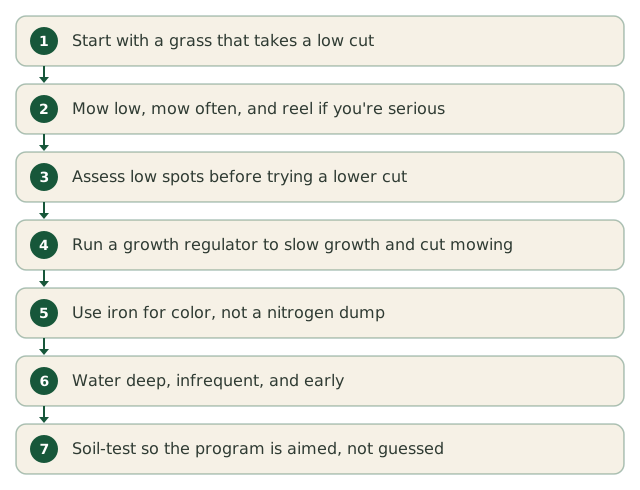
Start with a grass that takes a low cut
The fairway look comes from grasses bred to be mowed low and dense. In the warm-season South that's hybrid Bermuda (TifTuf, Tifway 419, or the dwarf types) and fine-bladed Zoysia (Zeon, Emerald) — common Bermuda is coarser and won't carpet the same way. Creeping bentgrass goes lower still but only if you're ready for a full greens program. Cool-season fescue and bluegrass can look stunning but won't take a sub-one-inch cut, so match your ambition to your grass before you buy a reel mower.
- Step 2
Mow low, mow often, and reel if you're serious
Density is built at the mower. Hybrid Bermuda and Zoysia hold a cut from roughly 1.5" down toward 0.5" on a rotary and below that on a reel; cool-season grasses want to stay 2.5–4". Drop the height in small steps rather than one scalp, and mow more often as you go lower — every 2–3 days at fairway heights so you're still inside the one-third rule each pass. A reel mower gives the cleanest cut and the tightest stripes; a sharp rotary at its lowest setting is a real starting point.
Never remove more than a third of the blade in one mow, and don't drop the height on a stressed lawn.
- Step 3
Assess low spots before trying a lower cut
Smoothing suitable low spots can reduce scalping, but the grass and site still determine an appropriate mowing height. Assess the cause first. For light leveling, use material compatible with the existing soil in shallow passes during healthy active growth, leaving leaf area exposed and time for recovery. Sand is mainly for sandy or purpose-built root zones and managed specialist programs; larger or recurring dips may need lifting and regrading instead.
- Step 4
Run a growth regulator to slow growth and cut mowing
A plant growth regulator (PGR) like Primo Maxx (trinexapac-ethyl) slows vertical growth by interfering with gibberellic-acid synthesis. Under good growing conditions, its label describes roughly 50% growth suppression for about four weeks, so the lawn needs mowing less often. Growing degree days (GDD) can help track heat between applications, but a tracking target does not establish when regulation ends. Follow the applicable product label and consider observed turf response before deciding whether to reapply.
Plant growth regulators are rate-sensitive — too much can discolor or stunt the lawn. Always read and follow the product label — it is the legal authority on rates, timing, and safety. These windows are regional estimates, not a prescription; defer to the label and your local extension office.
- Step 5
Use iron for color, not a nitrogen dump
The deep, almost blue-green color of a golf-course lawn comes from iron, not extra nitrogen. A foliar iron (ferrous sulfate or a chelated iron) darkens the lawn within a day or two without pushing the flush of growth that heavy nitrogen forces. Keep nitrogen moderate and on-program; reach for iron when you want color.
Plan about 1 lb of nitrogen per 1,000 sq ft per feeding or less — a conservative default, not a universal limit. Don't feed dormant or heat-stressed turf. Local fertilizer rules can be stricter than this and can override it: several states and counties set a lower per-application limit, cap the soluble (quick-release) fraction separately, require a share of slow-release nitrogen, or ban applications outright during a seasonal blackout. Check your state or county rules before you spread. Always read and follow the product label — it is the legal authority on rates, timing, and safety. These windows are regional estimates, not a prescription; defer to the label and your local extension office.
- Step 6
Water deep, infrequent, and early
Deep, infrequent morning watering drives roots down and keeps the canopy dry — the opposite of the daily sprinkle that invites disease on a low-cut lawn. Dial in the minutes per zone for your soil, and back off the moment the weather does the work for you.
- Step 7
Soil-test so the program is aimed, not guessed
A $15 soil test reports your pH and the nutrient levels your lab measures, rated on that lab's scale, so your feeding and any lime or sulfur follows its recommendation instead of a guess. Most lawn grasses do well around pH 6.0–7.0, though the target depends on the grass; well outside its range, some nutrients become harder for the grass to take up, which is why the lab's advice for your grass matters. The best lawns are built on soil chemistry, not on whatever bag was on sale.
The system that runs it
How YardLedger handles it
Great lawns are logged. YardLedger is the system behind the result: see how it all fits together.
- Equipment & product garage
- Log your reel mower, sprayer, and spreader alongside your PGR, iron, and fertilizer with their rates and application history — so every pass is repeatable and you never second-guess what you put down.
- Progress photos & side-by-side compare
- For a golf-course lawn, the transformation is the whole point. Snap the same angle over weeks and let YardLedger build the before/after — the proof your neighbors notice and the content that does the talking.
- Goal-oriented AI plans
- Use your lawn goal to draft a schedule, then review each action against your grass, site and current conditions. Forecast context can inform that review; it does not establish readiness to apply a treatment.
Start from a schedule built for your yard
An enthusiast lawn program sits on top of the basics done on time. Enter your grass type and ZIP in the free schedule generator for the month-by-month foundation — no signup required.
Open the schedule generatorA reminder when the season’s next job is due
We'll email you about three weeks before this ZIP's normal first freeze — while irrigation contractors still have slots, and before the backflow preventer is the part that freezes.
The blow-out reminder counts back from your metro's NOAA 1991–2020 median first freeze, not this year's forecast — a normal year, give or take a couple of weeks. Add your address and the reminder follows the live forecast for your own yard, with the checklist built around the zones and shut-offs you've mapped.
Questions on the way there
- Do I need a reel mower for a golf-course lawn?
- A reel mower isn't needed to start on a golf-course lawn. A sharp rotary at its lowest setting gets you a clean, low cut and real density, especially paired with a PGR and a leveling project. A reel mower gives the tightest cut and the crispest stripes, so most enthusiasts move to one once they've leveled and committed to mowing every few days.
- Can I get a golf-course lawn with cool-season grass?
- You can get a beautiful, dense, dark cool-season lawn, but not the sub-one-inch fairway cut — tall fescue and bluegrass need to stay taller. For the true low-mow fairway look, you want a warm-season grass like Bermuda or Zoysia, or a dedicated bentgrass setup.
- How long does it take to transform a lawn?
- The timeline for transforming a lawn depends on the grass, starting condition, site and work needed. Track observed progress without assuming a one-season outcome. Where gradual leveling is suitable, let healthy growth and recovery between shallow passes govern progress; larger corrections may need another repair approach. Logging work and comparing photos helps you assess change without assuming a deadline.
Where this guidance comes from
The university extension and public-agency publications listed here back specific statements on this page. Each publication says which statement it backs, so you can check the statement rather than take it on trust. Where a product label or your local extension office disagrees with anything here, follow the label or the extension office.
- Mowing Lawns (HGIC 1205)
Clemson Cooperative Extension
Bermuda and zoysia are the grasses that take a reel-mown low cut, and every mow should take no more than a third of the blade — the core of the low-mowing step on this page.
- Bermudagrass Lawn Maintenance Calendar
NC State Extension
A reel mower gives Bermuda its best low cut, while a sharp rotary set as low as it will go without scalping is a real starting point.
- Micro-nutrients for Sports Fields
Cornell University Sports Field Management
Iron darkens turf color without pushing extra leaf growth, which is why this page uses iron for color rather than more nitrogen.
