
Free · No signup required
First & Last Frost Dates by ZIP Code
Enter your ZIP code for your average first fall freeze and last spring freeze — from NOAA's long-term climate normals where a nearby station covers you, and a clearly-labeled USDA-zone approximation where one does not — plus the dates they actually set: when to overseed, when to winterize the sprinklers, when to expect the first freeze, and when it is safe to turn the irrigation back on. Free, no signup, and no email required to see the answer.
Free · no signup · NOAA 1991–2020 normals
Why your hardiness zone can't answer this
A USDA hardiness zone is the average annual extreme minimum temperature — how cold your winter gets at its worst. It says nothing about when the cold arrives, and the two come apart badly: Boise and New York City are both zone 7 — the same depth of winter cold — yet Boise's first freeze lands around October 21 and New York's around November 20, about four weeks later, because one sits in high dry interior air and the other is held up by the Atlantic. Anything timed off a zone alone — an overseeding window, a winterization deadline — inherits that error.
Where your ZIP matches a curated station, the frost dates this tool returns come from actual freeze observations: NOAA/NCEI 1991–2020 climate normals, specifically the 50th-percentile date of the first and last 32°F freeze at the curated station we match to your ZIP — usually a metro’s first-order airport station, chosen to represent the area rather than because it is the closest one. Of the years that freeze, half freeze earlier than the date shown; where a 32°F night does not come every year, the result says how often it does. That is why every job the dates set is scheduled to finish before the date rather than to happen on it.
Typical frost dates by USDA zone
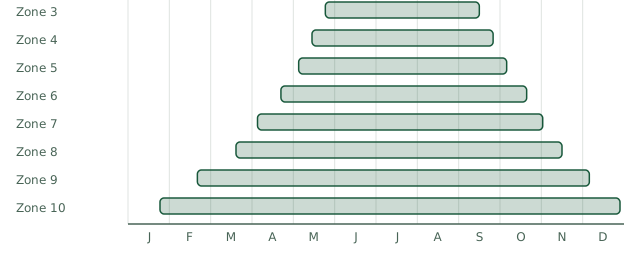
The USDA-zone frost dates below are a rough national reference across every zone we model, useful when you want a feel for the spread rather than an answer for one address. Enter your ZIP above for the real one.
| USDA zone | First fall freeze | Last spring freeze | Climate |
|---|---|---|---|
| Zone 3 | September 15 | May 25 | very cold northern winters |
| Zone 4 | September 25 | May 15 | cold northern winters |
| Zone 5 | October 5 | May 5 | cold winters |
| Zone 6 | October 20 | April 22 | cool winters |
| Zone 7 | November 1 | April 5 | mild transition-zone winters |
| Zone 8 | November 15 | March 20 | mild Southern winters |
| Zone 9 | December 5 | February 20 | warm winters with only occasional frost |
| Zone 10 | December 28 | January 25 | warm winters with only rare frost |
The dates in this table are zone-level approximations only — the fallback the tool uses when a ZIP has no nearby station, and the roughest figures on this page. In zones 9 and 10 especially, many locations go whole years without reaching 32°F at all, so read those rows as “if it freezes, roughly then” rather than as an annual date.
Frost dates, explained further
- What is a first frost date?
- A first frost date is the date by which, in a typical year, your area has had its first night at or below 32°F. The figures here are the 50th-percentile date from NOAA's 1991–2020 climate normals: of the years that freeze, half freeze earlier than the date shown and half later. Where a 32°F night does not come every year, the result says how often it does, because the date describes only the years that freeze.
- How accurate is a first frost date by ZIP code?
- A first frost date by ZIP code is a planning figure, not a forecast. The date is a median: in individual years the first freeze lands weeks earlier or later, and elevation, cold-air drainage and urban heat move the real date at a specific address. The band shown around it is a fixed 12-day planning band either side of the median, not each station's measured spread. Use it to schedule the work; use the forecast to decide the day.
- Is a frost the same as a freeze?
- Frost and freeze are not quite the same thing. Frost can form on surfaces at air temperatures slightly above freezing on a calm, clear night, and it damages tender plants. A freeze is the air itself at 32°F or below. The National Weather Service uses "hard freeze" for about 28°F or colder for several hours, a threshold set for plants. Whether irrigation pipe freezes also depends on how long the cold lasts and on how deep and well covered the pipe is, so no single temperature decides it — the backflow preventer and other parts above ground are exposed first. The dates here are 32°F freeze dates.
- Can I use my USDA hardiness zone instead?
- A USDA hardiness zone cannot stand in for a frost date, and using one that way is the single most common mistake in lawn-care advice. A hardiness zone is the average annual extreme minimum temperature — how cold it gets, not when. Boise and New York City are both zone 7, yet Boise freezes around October 21 and New York around November 20 — about four weeks apart in the same zone. Anything timed off a zone alone can be weeks wrong.
- Where does this data come from?
- The frost-date data comes from NOAA/NCEI 1991–2020 climate normals — specifically the 50th-percentile first and last 32°F freeze dates at one curated station per covered metro, usually its first-order airport station. Your ZIP is matched to a metro by its first three digits, not by distance, so the station is the one chosen to represent your area rather than necessarily the closest. If no curated metro covers your ZIP, the answer falls back to a USDA-zone approximation, and the tool says so rather than presenting it as a station reading.
- Do I need to winterize my sprinklers if I only get a few freezes?
- Whether a few freezes call for sprinkler winterization depends on how hard they get, and the tool answers it for your ZIP rather than in the abstract. Through USDA zone 8 the answer is usually yes: exposure is not proportional to how many freezes you get — one long, cold night with water still in an above-ground backflow preventer can be enough, and the repair costs the same whether it was the only cold night of the winter or the fortieth. Above zone 8 a 32°F night is common but long, deep cold is not, so a full blow-out is not standard practice — protect the backflow preventer and exposed pipe as their manufacturers direct, and disconnect hoses, when a freeze is forecast instead. Your result above says which of those applies to you.
