
Every lawn
Crabgrass Control: Which Option Is Still Open to You
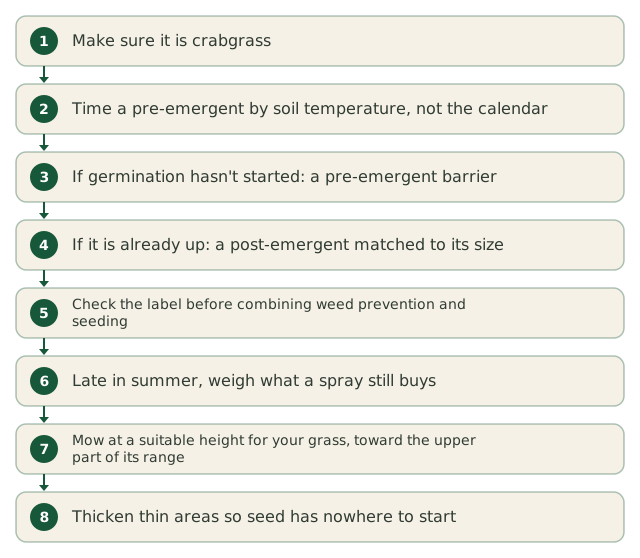
Crabgrass is a summer annual, so timing decides which control works. Before the top inch of soil holds about 55°F for several days, put down a pre-emergent labeled for your grass, and not where you are seeding unless the label allows it. Once plants are up, use a post-emergent labeled for their size; tillered plants are harder to control.
Crabgrass is a summer annual: it sprouts from seed each spring, spreads into a flat rosette through summer, starts setting seed around midsummer and, Cornell notes, keeps setting it until frost, and dies with the first killing frost in most of the country. Penn State notes a single plant can produce thousands of seeds, and UC IPM says they stay viable in the soil for at least three years, so this year's plants are mostly a problem for next year. Which control still makes sense depends on where you are in that cycle. Before the soil warms, a pre-emergent barrier. Once plants are up, a post-emergent labeled for your grass, which gets harder as they tiller. All year, mowing and a dense lawn that leave seed less light and room. Start by making sure it is crabgrass, because the look-alikes need different answers.
Which option is still open where you are?
Crabgrass starts germinating once your soil holds about 55°F, so whether a pre-emergent is still worth applying depends on where your soil is now. Enter your ZIP in the free pre-emergent check for the median crossing near you, how much of the window is left, and how far the earliest and latest years have run — no signup required.
Check my pre-emergent windowWant a heads-up when the next seasonal job is due?
We'll email you about three weeks before this ZIP's normal first freeze — while irrigation contractors still have slots, and before the backflow preventer is the part that freezes.
The blow-out reminder counts back from your metro's NOAA 1991–2020 median first freeze, not this year's forecast — a normal year, give or take a couple of weeks. Add your address and the reminder follows the live forecast for your own yard, with the checklist built around the zones and shut-offs you've mapped.
Your options, from soil temperature to fall thickening
- Step 1
Make sure it is crabgrass
Crabgrass is lighter green than most lawns and grows faster in summer. Its stems spread outward from one center in a rosette that lies nearly flat under low mowing. Penn State notes it has no auricles (the small claw-like flaps where blade meets sheath), and large crabgrass has sparse long hairs on the leaves. UC IPM says it is often confused with goosegrass and with two perennials, dallisgrass and bermudagrass. The difference matters: a perennial does not die at frost, and the crabgrass products below may not control it.
- Step 2
Time a pre-emergent by soil temperature, not the calendar
Penn State puts germination at about 55 to 58°F in the top inch of soil at daybreak for four or five days, with moisture present, and advises applying a pre-emergent about 10 to 14 days before the earliest expected germination. That date varies widely: our soil-temperature normals move it by more than two months across the country, and in one place it shifts from year to year. Warm spots, such as bare soil beside a drive, start first. Forsythia in full bloom is a common cue to get ready, but Penn State notes it is not always reliable when the weather is unusual. Not all seed germinates at once, so a barrier that goes down late can still stop later flushes, though it does nothing for plants already up.
- Step 3
If germination hasn't started: a pre-emergent barrier
A pre-emergent does not kill seed. It forms a layer in the top of the soil that stops seedlings as they emerge, so it has to be down and watered in as the label directs before germination. Spread it evenly at the labeled rate; when crabgrass comes up through a barrier, K-State suggests uneven delivery as one cause. Some products are labeled for a split program that covers a longer germination period, and some are one application for the year. Pick the product first, then follow its directions rather than a general rule.
Never exceed the label's annual total by splitting an application — where a split is permitted it is a division of the same yearly budget, not an addition to it, and the labeled interval is the one to use. Always read and follow the product label — it is the legal authority on rates, timing, and safety. These windows are regional estimates, not a prescription; defer to the label and your local extension office.
- Step 4
If it is already up: a post-emergent matched to its size
Young plants are the easiest to control, and K-State notes that once crabgrass tillers it becomes significantly harder and may need more than one application. K-State's guide to the common active ingredients:
Dithiopyr, a pre-emergent that also controls plants up to one tiller.
Mesotrione and topramezone, usually two applications, at a higher rate past one tiller.
Quinclorac, most effective at one tiller or less or past four tillers; UC IPM reports resistance in some populations.
Fenoxaprop, effective up to five tillers; Penn State warns against it on drought-stressed cool-season turf.
Heat raises the risk too. K-State advises against applying above 85°F, or outside whatever temperature limits the label states, because injury risk climbs. A cooler day does not make an application safe; the label decides.
Check that the label names your grass. Warm-season lawns differ most. On St. Augustine, UF/IFAS's Florida lawn weed guide says atrazine products can help control young grassy weeds, but UF/IFAS Extension in Clay County says nothing that controls actively growing crabgrass is safe there. Past the young stage, the fallback is hand-pulling, or spot-treating with a non-selective herbicide such as glyphosate, which kills the St. Augustine it touches too unless the lawn is a glyphosate-tolerant cultivar such as ProVista, as UF/IFAS describes it, and the product label allows it. Always read and follow the product label — it is the legal authority on rates, timing, and safety. These windows are regional estimates, not a prescription; defer to the label and your local extension office.
- Step 5
Check the label before combining weed prevention and seeding
Many pre-emergents can injure new grass. Choose your seeding date and weed-control product together, using its reseeding and new-turf directions.
Most conventional pre-emergents can injure seedlings or prevent establishment. Before seeding treated ground, follow the exact product's reseeding interval for the rate used; waits are often months, not weeks. Before treating newly seeded grass, follow its separate waiting, mowing and establishment requirements. Use a product at seeding only when its label allows your grass species, seed mixture, rate and timing. For crabgrass prevention while seeding cool-season grass, mesotrione products with new-seeding directions are an option only for the existing turf and seed mixture that product lists. Species and timing differ by product, especially for fine fescue; avoid over-application, particularly with perennial ryegrass.
- Step 6
Late in summer, weigh what a spray still buys
Once plants are large, heading out and only weeks from frost, much of this year's seed is already made and the plants are near the end of their life anyway. Spraying then mostly changes how the lawn looks this season. The effort may be better spent on next spring's barrier and on thickening thin areas. That is a judgment, not a rule: in a frost-free area plants can survive the winter, and UC IPM stresses controlling crabgrass before it sets seed.
- Step 7
Mow at a suitable height for your grass, toward the upper part of its range
Taller turf shades the soil surface. UMass says it keeps the soil cooler, and Penn State says regular mowing at about 3 inches helps deprive emerging crabgrass of light. K-State notes that even a half-inch higher makes a difference. Pick the height within your grass's own range; a scalped lawn and a crabgrass problem are often the same lawn.
- Step 8
Thicken thin areas so seed has nowhere to start
K-State calls a healthy, dense, actively growing lawn the best defense. Crabgrass colonizes bare and thin spots: along drives and walks where the surface bakes, where shade has thinned the grass, and where the mower scalps. For cool-season lawns, overseed those spots in early fall, when K-State notes weed pressure is far lower; warm-season lawns are repaired during their own growing season. Feeding matters too: K-State advises cool-season lawns to get most of their nitrogen in fall rather than summer.
Too late? Seeding? Aerating? The usual questions
- When should I apply crabgrass pre-emergent?
- Apply crabgrass pre-emergent before germination starts. Penn State puts that at about 55 to 58°F in the top inch of soil at daybreak for four or five days, and advises applying 10 to 14 days ahead. The date varies by location and year, so enter your ZIP in the free pre-emergent check for the median crossing near you and the earliest and latest it has been observed.
- Is it too late for crabgrass pre-emergent?
- Whether it is too late for a crabgrass pre-emergent depends on what has already come up. A barrier does nothing to plants already up, but crabgrass germinates over several weeks, so a product going down now can still stop later flushes. Dithiopyr also controls very young plants: Penn State and K-State put the limit at one tiller, and UC IPM says fewer than five leaves; check that your label lists that use and your grass. Past that, switch to a post-emergent labeled for the plant's size, and plan next year's barrier and fall thickening.
- Will crabgrass die on its own?
- Crabgrass usually dies on its own at the first killing frost, because it is an annual, though UC IPM notes it can survive the winter where there is no killing frost. Dying is not the same as going away: each plant drops seed first, and UC IPM says that seed stays viable for at least three years. Doing nothing mostly costs you next spring.
- Can I put down crabgrass preventer and grass seed together?
- Most conventional pre-emergents can injure seedlings or prevent establishment. Before seeding treated ground, follow the exact product's reseeding interval for the rate used; waits are often months, not weeks. Before treating newly seeded grass, follow its separate waiting, mowing and establishment requirements. Use a product at seeding only when its label allows your grass species, seed mixture, rate and timing. For crabgrass prevention while seeding cool-season grass, mesotrione products with new-seeding directions are an option only for the existing turf and seed mixture that product lists. Species and timing differ by product, especially for fine fescue; avoid over-application, particularly with perennial ryegrass.
- Does aerating remove crabgrass pre-emergent?
- If both jobs are needed, core-aerate before applying pre-emergent where practical. Colorado State Extension reports that core aeration does not reduce the effectiveness of a pre-emergent already applied, so aerating afterward does not automatically waste the application. Check the exact product label and local guidance, especially if seeding: many products inhibit grass establishment.
Where this guidance comes from
The university extension and public-agency publications listed here back specific statements on this page. Each publication says which statement it backs, so you can check the statement rather than take it on trust. Where a product label or your local extension office disagrees with anything here, follow the label or the extension office.
- Control of Annual Grassy Weeds in Lawns (3.101)
Colorado State University Extension
Core aeration does not reduce the effectiveness of a pre-emergent that has already been applied.
- Lawn and Turfgrass Weeds: Smooth Crabgrass and Large Crabgrass
Penn State Extension
Crabgrass germinates once the top inch of soil reaches about 55–58°F at daybreak for four or five days, so a pre-emergent goes down 10–14 days ahead; it is identified by its flat rosette and missing auricles, sets thousands of seeds from July to September, and is held back by regular mowing at about 3 inches.
- Pest Notes: Crabgrass (UC ANR Publication 7456)
UC Statewide IPM Program (UC IPM)
Crabgrass is an annual that can overwinter without a killing frost, is often confused with goosegrass, dallisgrass and bermudagrass, and leaves seed viable for at least three years; dithiopyr catches only very young seedlings, and some populations resist quinclorac.
- Biology and Management of Crabgrass
UMass Amherst Center for Agriculture, Food, and the Environment
Taller mowing shades and cools the soil surface, which crabgrass seed needs warm to germinate.
- Noticing Lighter Green Plants Growing Faster Than Your Turfgrass? Two Common Suspects
Kansas State University Turf and Landscape Newsletter
Post-emergent options by growth stage, the advice to avoid applying above 85°F or the label's lower limit because heat raises turf-injury risk, and dense turf, a slightly higher cut and fall feeding and seeding as the cultural defense.
- Consider Postemergence Crabgrass Control When Plants are Young (Now)
Kansas State University Turf and Landscape Newsletter
Crabgrass coming through a pre-emergent can mean the product was spread unevenly.
- Crabgrass in St. Augustinegrass Lawns
UF/IFAS Extension Clay County
No herbicide that controls actively growing crabgrass is safe on St. Augustine, so hand-pulling or a careful spot treatment is the fallback there.
- Weed Management Guide for Florida Lawns (ENH884/EP141)
UF/IFAS Extension
Atrazine products can help control young grassy weeds in St. Augustine and centipede lawns; otherwise only a few professional-grade products can be used after weeds emerge.
- Large Crabgrass (Weed Profile)
Cornell University Weed Science
Once large crabgrass starts flowering it keeps flowering and setting seed until frost.
- St. Augustinegrass for Florida Lawns (ENH5)
UF/IFAS Extension
ProVista St. Augustine is a glyphosate-tolerant cultivar, the exception to glyphosate killing St. Augustine it touches.
