
Irrigation timing by location
When to Winterize Sprinklers — by City, State and USDA Zone
Sprinkler winterization has no national date. The deadline is your own first hard freeze, and it moves by more than two months across the country — a system in Fargo is blown out while one in Atlanta is still running. Find your city, state or zone below for the window, then work the checklist. Places warm enough that a pipe-cracking freeze is not a realistic risk are deliberately not listed: if yours is missing, that is usually the answer.
If your place is not listed for sprinkler winterization, look up your ZIP code for the same answer from the station we match to your ZIP.
Every sprinkler winterization window below is a long-term normal, which is the best a static page can do. YardLedger can alert you to forecast freeze risk when your location, season and notification settings qualify. Forecasts and delivery can change; check local conditions yourself. Get my freeze reminder
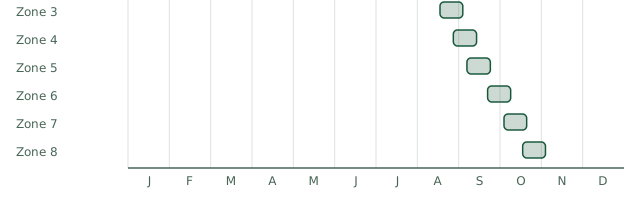
By USDA hardiness zone
USDA zones are the coarsest tier on this page — a zone measures winter cold rather than frost dates, so use it as a starting point and go a level deeper if your city or state is listed below.
When is your first freeze?
A zone is the coarsest tier on this page. Enter your ZIP for the NOAA freeze normals of the station we match to it — the deadline your winterization hangs off — free, no signup required.
Free · no signup · NOAA 1991–2020 normals
By state
Each state page is anchored to the earliest-freezing station in that state, not averaged across them — a statewide deadline has to clear the coldest county. States with no realistic pipe-cracking freeze are deliberately absent.
- Alabama
- Alaska
- Arizona's freeze country
- Arkansas
- California's freeze country
- Colorado
- Connecticut
- Delaware
- Georgia
- Idaho
- Illinois
- Indiana
- Iowa
- Kansas
- Kentucky
- Maine
- Maryland
- Massachusetts
- Michigan
- Minnesota
- Mississippi
- Missouri
- Montana
- Nebraska
- Nevada's freeze country
- New Hampshire
- New Jersey
- New Mexico
- New York
- North Carolina
- North Dakota
- Ohio
- Oklahoma
- Oregon
- Pennsylvania
- Rhode Island
- South Carolina
- South Dakota
- Tennessee
- Texas
- Utah
- Vermont
- Virginia
- Washington
- West Virginia
- Wisconsin
- Wyoming
By city
City pages cover 68 metros with a curated NOAA station — the most precise answer on the site short of entering your own ZIP.
- Albany, NY
- Albuquerque, NM
- Amarillo, TX
- Anchorage, AK
- Atlanta, GA
- Austin, TX
- Baltimore, MD
- Billings, MT
- Birmingham, AL
- Blairsville, GA
- Boise, ID
- Boston, MA
- Buffalo, NY
- Burlington, VT
- Charleston, WV
- Charlotte, NC
- Cheyenne, WY
- Chicago, IL
- Cincinnati, OH
- Cleveland, OH
- Colorado Springs, CO
- Columbia, SC
- Columbus, OH
- Dallas, TX
- Denver, CO
- Des Moines, IA
- Detroit, MI
- Duluth, MN
- El Paso, TX
- Fargo, ND
- Flagstaff, AZ
- Grand Rapids, MI
- Hartford, CT
- Indianapolis, IN
- Jackson, MS
- Kansas City, MO
- Klamath Falls, OR
- Little Rock, AR
- Louisville, KY
- Madison, WI
- Manchester, NH
- Memphis, TN
- Milwaukee, WI
- Minneapolis, MN
- Nashville, TN
- New York, NY
- Newark, NJ
- Norfolk, VA
- Oklahoma City, OK
- Omaha, NE
- Philadelphia, PA
- Pittsburgh, PA
- Portland, ME
- Portland, OR
- Providence, RI
- Raleigh, NC
- Reno, NV
- Richmond, VA
- Salt Lake City, UT
- Seattle, WA
- Sioux Falls, SD
- Spokane, WA
- Springfield, IL
- St. Louis, MO
- Tahoe City, CA
- Washington, DC
- Wichita, KS
- Wilmington, DE
Where this guidance comes from
The university extension and public-agency publications listed here back specific statements on this page. Each publication says which statement it backs, so you can check the statement rather than take it on trust. Where a product label or your local extension office disagrees with anything here, follow the label or the extension office.
- 1991-2020 U.S. Climate Normals: Annual/Seasonal Normals Documentation
NOAA National Centers for Environmental Information
City and state dates come from NOAA's 1991–2020 normals: the median (50% probability) dates of the first fall and last spring 32°F freeze at each curated station. Zone pages use a coarser zone-level approximation instead.
- U.S. Climate Normals
NOAA National Centers for Environmental Information
NOAA's U.S. Climate Normals publish freeze-related statistics, including probabilities, for thousands of stations — the dataset behind every state and city date here.
- Earliest/Mean/Latest First Fall Freeze Climatology
NOAA National Weather Service (Duluth, MN office)
A hard freeze of 28°F or lower for an hour or more can damage un-drained sprinkler systems — why the deadline is the first hard freeze, not a calendar month.
- USDA Plant Hardiness Zone Map
USDA Agricultural Research Service
Hardiness zones reflect the average coldest winter temperature, not frost dates, which is why the zone-level pages are labeled as approximations.
