
Every lawn
Mowing Height by Grass Type: How Tall to Cut Your Lawn
Cut within your grass species' healthy range, toward the upper part for many home lawns: about 2.5–4 inches for tall fescue, 2.5–3.5 for Kentucky bluegrass, 3–4 for Raleigh St. Augustine (3.5–4 for Floratam with a rotary mower), and 1–2.5 for common bermuda. Remove no more than a third of the blade per mowing; the table below lists every grass.
The right mowing height is a range that belongs to your grass species, and sometimes to its cultivar and the mower cutting it; the table compares every grass we cover. Within that range, the most common mistake is cutting too short. Purdue Extension lists it with mowing too seldom and with a dull blade as the usual problems, and notes that low mowing restricts roots and leaves turf more open to drought, insects, disease and weeds. Shade calls for more height. Summer heat is where sources split: Clemson Extension suggests a higher cut for stressed turf, while Illinois Extension and Purdue advise choosing a height and keeping it.
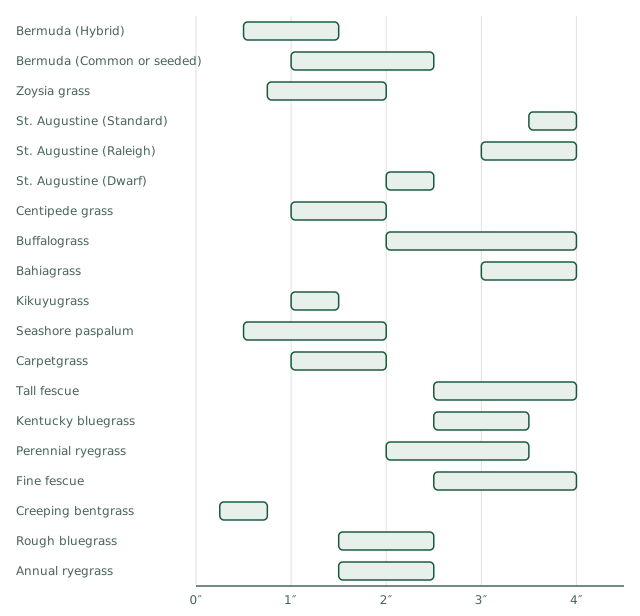
Mowing height by grass type
Every range below is where that species is healthiest, not where it merely survives. For many home lawns the upper part of the range is a sound default — more leaf, more shade at the soil surface, more tolerance for a missed week — though some cultivars and mower types have their own heights.
Warm-season grasses
| Grass | Mowing height | Its own note |
|---|---|---|
| Bermuda grass | Hybrid 0.5–1.5″Common or seeded 1–2.5″ | Hybrid bermuda looks best mowed short — 0.5–1.5", with a reel mower for the cleanest cut at low heights; common and seeded bermuda is mowed a little taller, around 1–2.5". Either way, mow frequently enough to remove no more than a third of the blade at once; at peak summer growth that can mean twice a week. |
| Zoysia grass | 0.75–2″ | Mow zoysia at roughly 0.75–2", and let cultivar, site and mower set where in that range: fine-bladed types cut with a reel mower can sit near the low end, while coarse cultivars and shaded lawns are often kept higher — some extension guidance goes to 2–2.5" for them. Its stiff blades dull rotary mowers quickly, so keep the blade sharp. Because it grows slowly, you'll mow less often than bermuda. |
| St. Augustine grass | Standard 3.5–4″Raleigh 3–4″Dwarf 2–2.5″ | Mowing height depends on the cultivar and the mower: with a rotary mower, keep standard St. Augustine tall — Floratam and Bitter Blue at 3.5–4", Raleigh at 3–4" — and dwarf cultivars (Seville, Captiva, Delmar) lower, around 2–2.5". Robotic mowers that cut very often are a documented exception: UF/IFAS lists Floratam at about 2.4" under robotic mowing, so follow guidance for your cultivar and mower type. Mowing a standard type too low for its mower scalps it and invites weeds and disease, while mowing a dwarf type too tall builds thatch and thins it. Keep the mower blade sharp to avoid shredding its wide blades. |
| Centipede grass | 1–2″ | Mow centipede at 1–2". It grows slowly, so you'll mow infrequently. Avoid scalping — its shallow roots recover slowly from stress. |
| Buffalograss | 2–4″ | Buffalograss can be mowed at 2–4" or left unmowed for a soft, informal meadow look — one of its main appeals. It grows slowly, so you will mow infrequently; mowing too often or too short mainly invites weeds without helping the stand. |
| Bahiagrass | 3–4″ | Mow bahiagrass at 3–4" with a sharp blade — its tough seed stalks dull mowers fast, and it sends up seedheads so quickly that you will mow often in summer just to keep them down. A dull blade shreds the coarse blades and leaves a ragged, whitish finish. |
| Kikuyugrass | 1–1.5″ | Kikuyugrass grows fast, so mow often and low — around 1–1.5" — to keep it dense and hold down thatch and stems. Let it get away from you and it turns puffy and stemmy; frequent mowing is the price of a tidy kikuyu lawn. |
| Seashore paspalum | 0.5–2″ | Seashore paspalum takes a low cut — 0.5–2", lower with a reel mower for a show surface. It builds thatch quickly at low heights, so mow frequently, keep the blade sharp, and plan on periodic dethatching or topdressing. |
| Carpetgrass | 1–2″ | Mow carpetgrass at 1–2", and expect to mow often in summer just to keep its fast, tall seedheads down — those seedstalks are its most-complained-about trait. A sharp blade keeps the coarse leaves from shredding. |
Cool-season grasses
| Grass | Mowing height | Its own note |
|---|---|---|
| Tall fescue | 2.5–4″ | Mow tall fescue at 2.5–4". Taller mowing shades the soil, conserves moisture, and helps it outcompete weeds in the heat. Going higher in summer is optional, and extension services differ: Clemson suggests a higher cut for turf under heat, drought or shade stress, while Illinois Extension recommends setting one height and leaving it, and Purdue advises against changing height through the year. |
| Kentucky bluegrass | 2.5–3.5″ | Mow Kentucky bluegrass at 2.5–3.5". Its rhizomes let it recover well, but consistent, sharp-blade mowing keeps it dense and discourages weeds. Going toward the higher end in summer is optional, and extension services differ: Clemson suggests a higher cut for turf under heat, drought or shade stress, while Illinois Extension recommends setting one height and leaving it, and Purdue advises against changing height through the year. |
| Perennial ryegrass | 2–3.5″ | Mow perennial ryegrass at 2–3.5". A sharp blade matters — ryegrass blades are fibrous and a dull mower leaves white, frayed tips. Mow regularly during its spring and fall flushes. |
| Fine fescue | 2.5–4″ | Mow fine fescue at 2.5–4", or let it grow for a relaxed, no-mow look. It grows slowly and needs infrequent mowing — one of its main appeals for shaded, low-traffic areas. |
| Creeping bentgrass | 0.25–0.75″ | Bentgrass is mowed lower than any other lawn grass — 0.25–0.75", and lower still on golf greens — which realistically means a reel mower and frequent cuts (often every 1–3 days in peak growth). Most home rotary mowers cannot cut cleanly this low; a few specialized rotary units reach about half an inch, but they still need level ground, a sharp blade and very frequent cuts. If you cannot mow low and often with suitable equipment, bentgrass is not the grass for you. |
| Rough bluegrass | 1.5–2.5″ | Mow rough bluegrass at 1.5–2.5", on the higher side in shade to keep as much leaf as possible working in low light. It is a fine, soft grass; a sharp blade and a normal cut are all it needs. |
| Annual ryegrass | 1.5–2.5″ | Mow annual ryegrass at 1.5–2.5" with a sharp blade — like other ryegrasses its fibrous blades fray under a dull mower. As temporary or overseed turf you will mow it through its short life and then let summer heat take it out. |
Ranges are for a healthy, established lawn. Within them, a steady height suits most home lawns, and a higher cut is an option for grass under heat, drought or shade stress. Never remove more than a third of the blade in one cut, whatever the setting says.
One reminder when the next seasonal date arrives
We'll email you about three weeks before this ZIP's normal first freeze — while irrigation contractors still have slots, and before the backflow preventer is the part that freezes.
The blow-out reminder counts back from your metro's NOAA 1991–2020 median first freeze, not this year's forecast — a normal year, give or take a couple of weeks. Add your address and the reminder follows the live forecast for your own yard, with the checklist built around the zones and shut-offs you've mapped.
The habits that make the height work
- Step 1
Find your grass's range, then choose your place in it
Every species has a range, and the ranges differ widely: tall fescue and bluegrass start about where bermuda, zoysia and centipede top out, while St. Augustine and buffalograss overlap them. Some cultivars and mowers have their own heights. Within the range, the upper part suits many home lawns: more leaf, more soil shade, more tolerance for a missed week. The bottom is for spreading warm-season grasses kept at close cut on purpose.
- Step 2
Measure what your mower actually cuts
The number on a mower's height lever is rarely the height of cut. UF/IFAS suggests parking the mower on a flat surface such as a driveway and measuring from the ground to the blade with a ruler. K-State adds that the real cut on the lawn can be a little different from that bench setting, because soft soil, wet conditions and a spongy thatch layer all affect it.
Before reaching near the blade, turn the mower off, wait for the blade to stop, and disconnect its power: pull the spark plug wire, remove the battery or unplug the cord, as the mower's manual directs.
- Step 3
Never remove more than a third of the blade in one cut
Cutting off more than about a third at once removes more leaf than the plant can quickly replace and can stall root growth while it recovers. If the lawn has gotten away from you, raise the mower and bring it down over several mowings rather than in one pass. The lawn recovers from being tall far more easily than from being scalped.
When the lawn is drought-stressed, don't make up for lost time with one hard cut. Purdue advises against mowing in midday heat above 90°F on dry soil; wait for the cooler early morning or evening.
- Step 4
Mow when the grass needs it, not on a fixed day
The one-third rule sets the schedule: mow before the grass has grown about half again its usual height, so no cut takes more than a third of the blade. Purdue notes some lawns need mowing twice a week in spring and fall and only every two weeks in summer. A weekly routine can fall behind in peak growth, and that is when scalping is most likely.
- Step 5
Raise the cut for shade; for summer heat it is optional
Shade is the clear case: Purdue recommends cutting a shaded lawn half an inch to an inch above the optimum height for its grass, because grass with less light needs more leaf. Keep the result within your grass's range; if you already mow at the top of it, stay there. Summer is a judgment call. Clemson Extension suggests a higher cut for turf under heat, drought or shade stress. Illinois Extension calls setting one height and leaving it the easiest strategy for most home lawns, and Purdue advises against varying it through the year. Either way, a taller cut works alongside sound watering rather than replacing it.
- Step 6
Sharpen the blade — height is wasted on a torn cut
A dull blade tears rather than cuts, leaving frayed tips that give the lawn a whitish or brownish cast and an easier way in for disease. Check the cut after mowing. Purdue notes blades may need sharpening four to six times a year.
- Step 7
Leave the clippings where they fall
Clippings are mostly water and break down rapidly, and they return nitrogen to the lawn: Penn State found Kentucky bluegrass clippings held roughly half of the nitrogen applied as fertilizer, and says returning them lets you cut back on feeding. At a normal mowing frequency they are not what builds thatch; thatch is mostly stems, crowns and roots, which decompose slowly. Clumps from an overdue mowing are the exception: they can smother the grass beneath, so break them up or rake them off once dry. If the lawn was treated with a broadleaf herbicide such as 2,4-D, MCPP or dicamba, Penn State advises keeping those clippings away from trees, shrubs and garden plants.
- Step 8
Keep mowing until growth stops; don't scalp it for winter
In fall, keep mowing at your usual height for as long as the grass grows, so it does not go into winter overgrown. A slightly shorter last cut is optional; Illinois Extension says it is not typically necessary, and a University of Wisconsin plant pathologist reports seeing no evidence that it prevents significant snow mold. Many lawns simply keep their usual height into winter. Clemson even raises bermuda slightly as nights cool. The few deliberate low cuts are specific jobs: a cleanup cut on dormant bermuda just before spring green-up, which Clemson describes, and scalping a warm-season lawn before winter overseeding so seed reaches soil.
The advice worth questioning
- The belief
- “Cutting the lawn short means it will be longer before it needs mowing again.”
- What’s actually happening
- Mowing is due once a cut back to your height would take off a third of the blade, so a short lawn is due again sooner: one kept at two inches needs cutting after roughly an inch of growth, one kept at four inches after about two. A hard cut also removes the leaf the grass uses to make energy, and a lawn kept below its range tends to root more shallowly.
- What it leads to
- Mowing short to save time leaves a lawn that browns sooner in dry weather and lets light reach the soil where crabgrass seed germinates, so the lawn asks for more watering and weed control on top of more frequent mowing. A cut that takes more than a third of the blade at once can scalp and thin the lawn as well.
- What to understand instead
- Mow within your grass's range — toward the upper part for many home lawns — and take no more than a third of the blade in a single cut; the table on this page gives the range for each grass we cover. Some warm-season grasses, such as bermuda and zoysia, are kept shorter by design — but that trade asks for more frequent mowing, not less.
Short or long, the one-third rule, and summer height
- How tall should I cut my grass?
- The right mowing height depends on the grass species, and the spread is wide — tall fescue and Kentucky bluegrass want several times the height that a close-cut bermuda lawn does. The comparison table above lists every grass we cover. Within your grass's range, the upper part is a sound default for many home lawns, while some cultivars and mower types have their own heights. Shaded lawns do better a little higher.
- Is it better to cut grass short or long?
- For many home lawns, cutting toward the longer end of the grass's range is better than cutting short. Purdue notes that mowing below the optimum height restricts roots and makes turf more susceptible to drought, insects, disease and weeds. Short cutting is a maintenance choice for spreading warm-season grasses, and the one-third rule means it takes more frequent mowing.
- What is the one-third rule?
- The one-third rule says never remove more than a third of the leaf blade in a single mowing. Taking more removes leaf the plant needs to make food and can slow root growth while it recovers. If the lawn has got long, raise the mower and step it down over several cuts instead of scalping it back in one pass.
- Should I mow higher in summer?
- Mowing higher in summer is optional, and extension services disagree on it. Clemson suggests a higher cut for turf under heat, drought or shade stress. Illinois Extension recommends setting one height and leaving it, and Purdue advises against changing height through the year. If you do raise it, stay within your grass's range and keep watering sensibly; a taller cut does not replace that.
- Do grass clippings cause thatch?
- At a normal mowing frequency, grass clippings do not cause thatch. Thatch is mostly stems, crowns and roots, which are slow to decompose; clippings are mostly leaf tissue and water and break down rapidly, according to Penn State. Returning them recycles nitrogen. What does contribute is heavy nitrogen feeding; clumps from an overdue mowing don't build thatch, but they can smother the grass underneath.
Where this guidance comes from
The university extension and public-agency publications listed here back specific statements on this page. Each publication says which statement it backs, so you can check the statement rather than take it on trust. Where a product label or your local extension office disagrees with anything here, follow the label or the extension office.
- Mowing, Dethatching, Aerifying and Rolling Turf (AY-8-W)
Purdue Extension
Cutting below the grass's optimum height restricts roots and leaves turf more vulnerable to drought, pests and weeds; shaded lawns go half an inch to an inch higher; Purdue keeps one height all year, mows by growth, sharpens blades four to six times a year, and avoids midday heat above 90°F on dry soil.
- Mowing Lawns (HGIC 1205)
Clemson Cooperative Extension
Remove no more than a third of the blade in one cut, since more can stall root growth, and raise the cut for grass under heat, drought or shade stress.
- Mowing Your Lawn
Illinois Extension
Setting one height and keeping it is the easiest strategy for most home lawns, a slightly shorter last cut is optional, and returned clippings break down, do not cause thatch and recycle nitrogen.
- Recycling Turfgrass Clippings
Penn State Extension
Returned clippings decompose rapidly, do not cause thatch and carry back roughly half the nitrogen applied as fertilizer, and clippings from herbicide-treated turf stay away from trees, shrubs and gardens.
- Mowing Your Florida Lawn (ENH10)
UF/IFAS Extension
Measure the mower's real height of cut on a flat surface with a ruler.
- Lawn Problem Solver: Scalping Turf
Kansas State University Turfgrass
The height measured on a hard surface can differ from what the mower cuts on the lawn, where soft soil, wet conditions and thatch change it.
- Bermudagrass Yearly Maintenance Program (HGIC 1216)
Clemson Cooperative Extension
Dormant bermuda gets a low cleanup cut just before spring green-up, and the cut is raised slightly as nights cool in fall.
- Watch: Fall 'Lawndry' List
University of Wisconsin–Madison Division of Extension
A short last cut of the season has not been shown to prevent significant snow mold.
