
Every lawn
Nutsedge: How to Identify It, and Why Your Weed Killer Did Nothing
Nutsedge is a sedge, not a grass or a broadleaf, which is why ordinary weed killers miss it; roll a stem and it feels solid and triangular. Treat young plants in early summer with a product labeled for sedges and safe on your grass, or hand-pull them and their regrowth. An established stand can take two to three years.
Nutsedge is often treated twice before anyone works out what it is. It looks enough like grass to be ignored, grows faster than the lawn so it stands up within days of mowing, and shrugs off the weed killer that handles everything else. That is because it is a sedge, neither a grass nor a broadleaf, and Purdue Extension notes the usual dandelion and crabgrass products are ineffective against it. It survives on tubers, or nutlets: a single plant can produce several hundred in a summer, Purdue says, and they outlast the leaves. So control is a matter of years, and it starts with identification, then removing the young plants or treating them with a product labeled for sedges, and fixing the wet ground it favors.
Identify it, then treat it young and fix the conditions
- Step 1
Confirm it is nutsedge: roll the stem between your fingers
A nutsedge stem is solid and triangular, so you can feel three edges when you roll it between finger and thumb; UC IPM notes a grass stem is hollow and round or flattened. Nutsedge leaves grow in sets of three from the base, where grass leaves come off in pairs. It grows noticeably faster than the lawn in summer, so a patch standing above the turf within a few days of mowing is a useful clue.
- Step 2
Work out which one you have, and rule out kyllinga
Yellow nutsedge is light yellow-green with leaves that taper to a fine point, and forms one tuber at the end of each underground stem. Purple nutsedge is darker, with blunter leaf tips and tubers in chains, and UT Extension notes it is harder to control. Yellow is the more widespread of the two because it tolerates cold better; purple is mainly a problem in warmer, southern areas. Kyllinga is the other common look-alike in warm and transition-zone lawns: Virginia Tech describes it as finer textured, forming dense mats rather than patches, with a round seedhead. Labels differ between these plants, so the identification decides the product.
- Step 3
Understand why the usual weed killer did nothing
Ordinary lawn weed killers are made for broadleaf weeds or for grassy weeds such as crabgrass, and Purdue notes they are ineffective against nutsedge. It needs an active ingredient labeled for sedges. Virginia Tech names bentazon, halosulfuron, imazaquin and sulfentrazone, and calls sulfentrazone and halosulfuron the most effective on yellow nutsedge; pyrimisulfan is a newer granular option. Some all-in-one lawn weed products already include sulfentrazone, but Purdue rates several of them only fair on nutsedge, below the dedicated sedge products. Follow the label on mixing: Clemson notes some halosulfuron products need a nonionic surfactant added. Don't reach for glyphosate: Purdue warns it is nonselective and will kill the lawn along with the weed.
Grass tolerance differs by product. Clemson notes halosulfuron is labeled for tall fescue, bermuda, centipede, zoysia and St. Augustine lawns, while UT Extension notes imazaquin is for warm-season turf only, and Texas A&M notes some sulfentrazone combinations may not be labeled for St. Augustine or centipede. Purdue and Clemson advise against treating drought-stressed turf or in heat around 90°F and above. Match the label to your grass by name. Always read and follow the product label — it is the legal authority on rates, timing, and safety. These windows are regional estimates, not a prescription; defer to the label and your local extension office.
- Step 4
Pull it young, and keep pulling the regrowth
Hand-pulling works on young nutsedge: take out as much of each plant as you can before it has about five or six leaves, which is before it forms new nutlets, and keep removing the regrowth every two to three weeks through summer. Each new sprout spends energy the tuber would otherwise store, so steady removal wears it down. Pulling a mature plant leaves the nutlets it has already made in the soil to resprout, and UC IPM notes tubers can survive one to three years. For a small established patch, UC IPM's alternative is to dig it out at least 8 inches deep, refill, and seed or sod.
- Step 5
Treat young plants in early summer, before tubers form
Purdue calls applying herbicide too late, once plants are big and making tubers, the most common mistake. Clemson notes plants start forming tubers once they have five or six leaves, which is May or June in South Carolina; Penn State, farther north, has tubers maturing in mid to late summer. Virginia Tech puts the best window in early to mid-summer, while plants are young and growing, though late-summer treatment still gives appreciable control. There is no pre-emergent fix for home lawns: UC IPM notes no pre-emergent that controls nutsedge can be used on turf.
- Step 6
Ask why that spot is wet
UC IPM notes nutsedge thrives in waterlogged soil and often marks poor drainage, watering that is too frequent, or a leaking sprinkler. Look for a low corner, a downspout outlet, a leaking head or a strip that ponds after rain, and fix it. That is what lets control last, but it is not the whole answer: once established, nutsedge tolerates normal watering and even drought, and Purdue notes it also shows up in well-drained spots where turf is thin. Keep removing or treating sprouts while the grass fills in.
- Step 7
Water deeply and infrequently, and don't mow too short
Frequent light watering keeps the surface damp, which favors nutsedge; Clemson advises watering established lawns deeply but infrequently. Purdue notes nutsedge is worst in turf mown too short, and Virginia Tech says mowing at the higher recommended heights helps shade it out, so choose a suitable height for your grass and avoid scalping. Purdue notes tubers can also arrive in topsoil and fill, so a new-construction lawn can have it from the start.
- Step 8
Plan on two to three years, and treat the survivors
No single application clears an established stand, because dormant tubers that haven't sprouted are untouched. Purdue's guidance is to repeat the treatment four to eight weeks later if plants regrow, as the label allows, and to expect two to three years of control to cut the viable tubers in the soil by 90 percent. Plants coming back after the first round is expected, not a sign the product failed.
Want a reminder for the next seasonal job?
We'll email you about three weeks before this ZIP's normal first freeze — while irrigation contractors still have slots, and before the backflow preventer is the part that freezes.
The blow-out reminder counts back from your metro's NOAA 1991–2020 median first freeze, not this year's forecast — a normal year, give or take a couple of weeks. Add your address and the reminder follows the live forecast for your own yard, with the checklist built around the zones and shut-offs you've mapped.
Why it survived, and whether it goes away
- How do I identify nutsedge?
- To identify nutsedge, roll a stem between your fingers: a nutsedge stem is solid and triangular, while a grass stem is hollow and round or flattened. Nutsedge leaves grow in sets of three rather than in pairs, and the plant grows fast enough to stand above the lawn within a few days of mowing. Yellow nutsedge is light yellow-green; purple is darker.
- Why didn't my weed killer kill the nutsedge?
- Ordinary lawn weed killers target broadleaf weeds or grassy weeds, and Purdue notes they are ineffective against nutsedge, which is a sedge. You need an active ingredient labeled for sedges, such as halosulfuron or sulfentrazone, and labeled for your grass species, because tolerance varies between turf types. Timing matters too: young plants in early summer respond best.
- Should I pull nutsedge?
- Pulling nutsedge is worth doing while the plant is young. Pull plants before they have about five or six leaves, before they form new nutlets, and pull the regrowth every few weeks, which wears the tubers down. A mature plant has already left nutlets in the soil, viable for years, and pulling it will not remove them. For an established patch, treat it with a sedge herbicide labeled for your grass, or change the conditions that favor it.
- Does nutsedge mean my lawn has a drainage problem?
- Nutsedge often points to a drainage or overwatering problem: UC IPM notes its presence often indicates poor drainage, too-frequent irrigation or a leaky sprinkler. Fixing the water makes control last, but established nutsedge tolerates drier conditions too, and Purdue notes it also invades thin turf on well-drained ground, so expect to keep treating while the lawn thickens.
- Will nutsedge go away on its own?
- Nutsedge top growth dies back in fall, but the tubers survive in the soil and sprout again the next year, so the stand returns and can spread. It is a perennial with an underground bank, not an annual you can wait out. Purdue expects two to three years of control to reduce the tubers substantially.
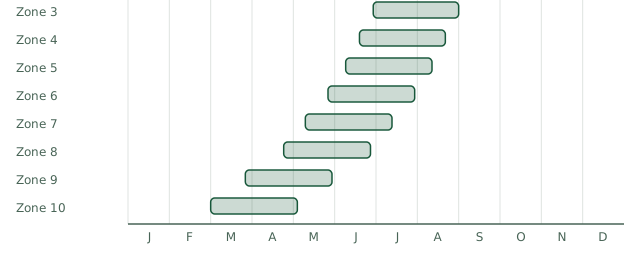
Treat it young, in early summer
The windows below are timed off frost dates rather than the calendar — the same job happens more than a month apart across the country.
Both lawn types — treat while plants are young, in early summer
Treat young plants: Clemson notes tubers start to form past five or six leaves, and Penn State finds the 3- to 8-leaf stage most effective. Virginia Tech still finds appreciable control later in summer, but each week closer to frost gives less.
| USDA zone | Window |
|---|---|
| Zone 3 | June 29 – August 31 |
| Zone 4 | June 19 – August 21 |
| Zone 5 | June 9 – August 11 |
| Zone 6 | May 27 – July 29 |
| Zone 7 | May 10 – July 12 |
| Zone 8 | April 24 – June 26 |
| Zone 9 | March 27 – May 29 |
| Zone 10 | March 1 – May 3 |
The windows in each table above are zone-level approximations from long-term freeze normals. A hardiness zone measures winter cold rather than frost dates, so check your own local dates — and where the job is driven by soil temperature, let that have the final say.
Count your early-summer window from your last freeze
The table above is a zone average. Enter your ZIP for the NOAA freeze normals of the station we match to it — first fall freeze and last spring freeze both — free, no signup required.
Free · no signup · NOAA 1991–2020 normals
Where this guidance comes from
The university extension and public-agency publications listed here back specific statements on this page. Each publication says which statement it backs, so you can check the statement rather than take it on trust. Where a product label or your local extension office disagrees with anything here, follow the label or the extension office.
- Pest Notes: Nutsedge (UC ANR Publication 7432)
UC Statewide IPM Program (UC IPM)
Nutsedge has a solid, triangular stem and leaves in threes; it often marks poor drainage or overwatering but tolerates drier conditions once established; small plants are pulled before five or six leaves, every two to three weeks in summer; small patches can be dug out; tubers last one to three years; and no turf pre-emergent controls it.
- A Problem Weed: Controlling Yellow Nutsedge in Lawns (TURF-45-W)
Purdue Extension
Nutsedge is a sedge that the usual dandelion and crabgrass products miss; one plant makes several hundred tubers; it favors short-mown, wet or thin turf and arrives in topsoil; treat early, not above 90°F, repeat four to eight weeks later, never with glyphosate on a lawn, and expect two to three years.
- Lawn and Turfgrass Weeds: Yellow Nutsedge (Cyperus esculentus)
Penn State Extension
Treat nutsedge while plants are young in early summer, before they build this year's crop of underground tubers; a few plants can be hand-pulled soon after they emerge, before tubers form.
- Nutsedge (HGIC 2312)
Clemson Cooperative Extension
Tubers start forming once plants pass five or six leaves (May or June in South Carolina); halosulfuron is labeled on the common Southern lawn grasses; yellow nutsedge is the more widespread; and treatments avoid hot, dry weather above 90°F.
- Driving Homeowners 'Nuts': Sedge in the Lawn (SPES-344NP)
Virginia Cooperative Extension
Kyllinga is the common look-alike; the sedge herbicides to look for are bentazon, halosulfuron, imazaquin and sulfentrazone (sulfentrazone and halosulfuron most effective on yellow nutsedge) plus pyrimisulfan; early to mid-summer is best, late summer still useful; and a higher cut helps shade it out.
- Nutsedge and Kyllinga Species (W 260)
University of Tennessee Extension
Purple nutsedge is harder to control than yellow, imazaquin is for warm-season turf only, and in poorly drained areas lasting control needs the drainage fixed.
- Nutsedge and Kyllinga Control for Homeowners (ESC-027)
Texas A&M AgriLife Extension
Yellow nutsedge leaves taper to a fine point and purple ones end bluntly, and sulfentrazone combination products may not be labeled for St. Augustine or centipede.
