
Cool-season lawns
Spring Overseeding: When It's Worth It, and How to Make It Take
Spring overseeding works, but less reliably than fall for cool-season grass. Seed as early as the ground allows, even before it warms; choose tall fescue or perennial ryegrass over straight Kentucky bluegrass; and plan for crabgrass, because most conventional preventers can injure new grass. Expect to water through the first summer.
For cool-season lawns, late summer to early fall is the more reliable time to seed. Penn State Extension notes that fall seedings face less weed competition and get two cool growing seasons before their first summer heat. Spring seeding can still work, and Purdue lists winter-thinned turf and damage from grubs or drought among the reasons to try it. The difficulties are specific. Seedlings get only a few months to root before summer, and Rutgers calls summer annual weeds such as crabgrass the main reason spring seedings fail, because most conventional crabgrass preventers can also injure new grass. What helps most is seeding early, choosing a grass that establishes quickly, and having a plan for both crabgrass and summer watering.
The decisions that make a spring seeding work
- Step 1
Decide whether to seed now or wait for fall
Spring seeding earns its extra effort when bare or badly thinned areas would otherwise fill with weeds or wash out before fall: winter damage, grub or drought damage, a dug-up patch. If the lawn is only somewhat thin and can wait, fall is usually the more reliable season for the same seed. Check your watering too. If restrictions or your schedule mean you can't water through the first hot spells, fall is the safer choice.
- Step 2
Seed as early as the ground allows, even before it warms
Purdue's advice is that the earlier you seed, the more time roots have before summer, and its spring-seeding fact sheet prefers dormant seeding during winter, or seeding in early April. Seed sown into cold soil waits to sprout; Rutgers notes cool-season seed won't germinate until soil stays above about 50°F. The practical limit is the ground: avoid working soggy spring soil. Seeding in June or July is a riskier job, and University of Minnesota turf researchers suggest you might want to wait.
- Step 3
Choose a grass that establishes quickly
Purdue finds spring seedings more successful with tall fescue and perennial ryegrass than with Kentucky bluegrass, which germinates slowly; bluegrass seeded alone in spring tends to establish only marginally by summer. Tennessee Extension, in the transition zone, advises against seeding bluegrass in spring at all. If you want bluegrass in the lawn, sow it in a mix with a faster species in spring, or wait for fall.
- Step 4
Plan for crabgrass without harming the seed
Most conventional crabgrass preventers, prodiamine and dithiopyr among them, can injure seedlings or prevent establishment, so don't apply them where you are seeding unless the label's directions allow it. Purdue also warns against reseeding ground already treated this spring; the product label sets that wait, and it is often months. Rutgers names two active ingredients usable at seeding. Siduron, where you can find it, controls crabgrass for only three or four weeks according to Purdue. Mesotrione can be used at seeding on the grasses and mixtures its label lists. Rutgers cautions that neither is likely to give season-long control where weed pressure is heavy. Otherwise, manage crabgrass after it appears with a post-emergent whose label covers new turf.
Do not apply a conventional crabgrass pre-emergent over spring seeding. Always read and follow the product label — it is the legal authority on rates, timing, and safety. These windows are regional estimates, not a prescription; defer to the label and your local extension office.
- Step 5
Get the seed into contact with soil
Seed resting on thatch or dead grass seldom establishes. Purdue recommends preparing the soil for good seed-to-soil contact and spreading the seed in two to four passes in different directions for even coverage. Core aeration first is one option, and the two jobs can be combined. Seed that lands in the holes can grow faster than seed between them, though, so spread it evenly across the whole area.
- Step 6
Plan to water through the first summer
Purdue's advice is to keep irrigating through the summer until the new grass has an adequate root system. Rain alone is often not enough in hot, dry spells, and Minnesota turf researchers warn that hot, windy days can kill new seedlings that don't get timely water. Watering restrictions matter here; some cities offer a temporary exception for new lawns.
- Step 7
Look again in late summer
If thin spots remain by late summer, overseed them in the fall window, when new seedlings face less weed competition and have cooler weather ahead.
The spring window, zone by zone
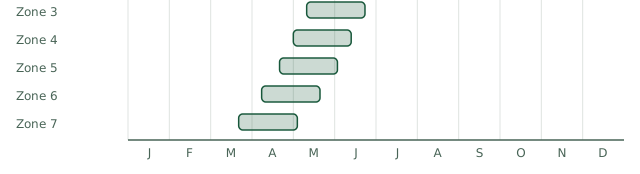
The windows below are timed off frost dates rather than the calendar — the same job happens more than a month apart across the country.
Spring seeding window
A frost-based estimate. Seed can go down before the soil warms: it waits, then germinates once soil stays above about 50°F (Rutgers). Earlier in the range gives roots more time before summer.
| USDA zone | Window |
|---|---|
| Zone 3 | May 11 – June 22 |
| Zone 4 | May 1 – June 12 |
| Zone 5 | April 21 – June 2 |
| Zone 6 | April 8 – May 20 |
| Zone 7 | March 22 – May 3 |
The windows in each table above are zone-level approximations from long-term freeze normals. A hardiness zone measures winter cold rather than frost dates, so check your own local dates — and where the job is driven by soil temperature, let that have the final say.
How early can you start where you live?
The table above is a zone average. Enter your ZIP for the NOAA freeze normals of the station we match to it — first fall freeze and last spring freeze both — free, no signup required.
Free · no signup · NOAA 1991–2020 normals
Get a nudge when the next seasonal job comes round
We'll email you about three weeks before this ZIP's normal first freeze — while irrigation contractors still have slots, and before the backflow preventer is the part that freezes.
The blow-out reminder counts back from your metro's NOAA 1991–2020 median first freeze, not this year's forecast — a normal year, give or take a couple of weeks. Add your address and the reminder follows the live forecast for your own yard, with the checklist built around the zones and shut-offs you've mapped.
Seeding or pre-emergent — which window comes first for you?
Many crabgrass preventers can injure new grass. Check the exact product's reseeding interval for treated ground and its separate new-turf requirements before combining the jobs. Enter your ZIP in the free pre-emergent check to see when the crabgrass window opens near you, so you can sequence the two on purpose — no signup required.
Check my pre-emergent windowThe advice worth questioning
- The belief
- “Spring is the natural time to seed a cool-season lawn, when everything starts growing.”
- What’s actually happening
- Cool-season seed does germinate in spring, but the seedlings get only a few months to build roots before summer heat, and they come up alongside crabgrass, which germinates as the soil warms. Seeded in early fall, the same grass sprouts in warm soil as the air cools and weed pressure falls away, and gets a long, mild stretch to establish before its first summer.
- What it leads to
- Seeding in spring narrows weed-prevention options: the exact product label must permit the new grass, seed mixture, rate and stage. It also means managing crabgrass and nursing young grass through its first summer — and possibly reseeding thin patches in fall anyway.
- What to understand instead
- For cool-season lawns, early fall is the more reliable window, and waiting for it is usually worth it. Spring seeding can still work when a lawn is too thin to wait, and the steps on this page give it its best chance. Warm-season grasses keep a different calendar: they are seeded from late spring into early summer, once the soil is warm.
Spring or fall, and the crabgrass problem
- Does spring overseeding work?
- Overseeding in spring works, but less reliably than fall. Spring seedlings have only a few months to root before summer heat, and they compete with crabgrass. Before adding a pre-emergent, check that its exact label permits your grass species, seed mixture, rate and seeding stage. Spring seeding is most worthwhile for bare or badly thinned areas that would otherwise fill with weeds before fall.
- When should I overseed in spring?
- Overseed in spring as early as you can work the ground without compacting wet soil. Seed can even go down in late winter: it waits in cold soil and germinates once the soil stays above about 50°F. The later into spring you seed, the less time roots have before summer, and seeding in June or July is usually better postponed to late summer.
- Which grass seed is best for spring overseeding?
- For spring overseeding, Purdue finds tall fescue and perennial ryegrass establish more successfully than Kentucky bluegrass, which germinates slowly and, seeded alone, tends to establish only marginally by summer. Tennessee Extension advises against seeding bluegrass in spring at all. If you want bluegrass, mix it with a faster species or wait for fall.
- Can I use crabgrass preventer if I overseed in spring?
- Most conventional pre-emergents can injure seedlings or prevent establishment. Before seeding treated ground, follow the exact product's reseeding interval for the rate used; waits are often months, not weeks. Before treating newly seeded grass, follow its separate waiting, mowing and establishment requirements. Use a product at seeding only when its label allows your grass species, seed mixture, rate and timing. For crabgrass prevention while seeding cool-season grass, mesotrione products with new-seeding directions are an option only for the existing turf and seed mixture that product lists. Species and timing differ by product, especially for fine fescue; avoid over-application, particularly with perennial ryegrass. If no labeled treatment fits, plan on managing crabgrass after it appears; any post-emergent must also meet its new-turf directions.
- Is dormant seeding better than spring seeding?
- Dormant seeding is an alternative, and Purdue's spring-seeding fact sheet prefers it or early April seeding to a later spring sowing. Seed spread once soil stays below about 40°F sits through winter and germinates in spring. University of Minnesota Extension notes that the freeze-and-thaw cycle helps work the seed into the soil. The tradeoffs: most crabgrass pre-emergents can't be used the following spring, and Rutgers notes that losses to washouts and birds lead many to raise seed rates by 30 to 50 percent.
- Is fall or spring better for overseeding?
- For cool-season grass, fall is usually the better season for overseeding: warm soil for germination, cooler nights, less competition from summer weeds, and, as Penn State puts it, two cool growing seasons before the first summer heat. If you can wait until late summer or early fall, that is the more reliable use of the same seed.
Where this guidance comes from
The university extension and public-agency publications listed here back specific statements on this page. Each publication says which statement it backs, so you can check the statement rather than take it on trust. Where a product label or your local extension office disagrees with anything here, follow the label or the extension office.
- Seeding a Turf Area in the Spring (AY-20)
Purdue Extension
Thin turf from winter, grub or drought damage can warrant spring seeding; dormant or early April seeding is preferred; siduron is the at-seeding exception, controlling crabgrass for only 3 or 4 weeks; spread in several passes; and water through the first summer.
- Seed Early in the Spring for Better Success
Purdue University Turfgrass Science
Spring seedings do better with tall fescue and perennial ryegrass than with Kentucky bluegrass alone, earlier seeding gives more rooting time before summer, and ground treated with a pre-emergent this spring should not be reseeded.
- Lawn Management through the Seasons
Penn State Extension
Fall seeding is more reliable than spring because weed competition fades and seedlings get two cool growing seasons before their first summer heat.
- Weed Control in Spring Seedings
Rutgers Center for Turfgrass Science
Summer annual weeds are the main reason spring seedings fail; conventional crabgrass preventers are not an option at seeding, and mesotrione or siduron may not give season-long control under heavy weed pressure.
- Mild winter, what does it mean for overseeding of turf or dormant seeding?
Rutgers Center for Turfgrass Science
Cool-season seed waits until soil stays above about 50°F to germinate, and dormant seedings lose more seed, so rates are often raised 30 to 50 percent.
- Dormant seeding to establish or improve your lawn
University of Minnesota Extension
Dormant seeding goes down once soil is below 40°F and relies on winter freeze-and-thaw for seed contact, but rules out most crabgrass pre-emergents the next spring.
- Turfgrass Establishment: When to Plant Turfgrasses (W160-F)
University of Tennessee Extension
In the transition zone, Kentucky bluegrass should not be seeded in spring because it germinates slowly compared with fescues and ryegrasses.
- Seeding your lawn in June or July? You might want to wait
University of Minnesota Turfgrass Science
Seedings that run into early summer face hot, windy days that can kill them without timely watering, and watering restrictions can make that hard, though some cities grant new-lawn exceptions.
