
Spring through summer
Bermuda Lawn Care Schedule: Month-by-Month for a Dense, Dark-Green Lawn
Bermuda rewards a tight program more than almost any home lawn: feed it through its summer peak, regulate it for density, and color it with iron, and it turns into a carpet. This is the enthusiast's month-by-month — the version that chases golf-course density, not just survival. For the region-tuned basics, pair it with your personalized Bermuda schedule.
Want the region-tuned basics first? See the Bermuda lawn care schedule by month & zone, then come back here for the density-and-color program.
The system, step by step
- Step 1
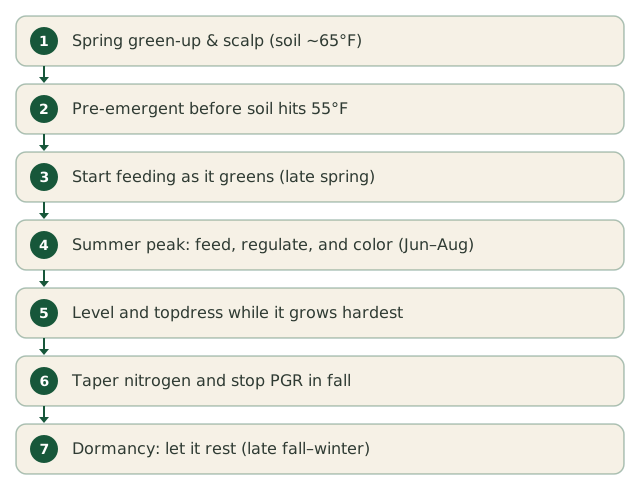
Spring green-up & scalp (soil ~65°F)
Once nights stay warm and the lawn is greening from the base, scalp it down low and bag the clippings to pull out winter debris and reset the height for the season. This wakes the canopy up and sets the low base you'll build density from.
Scalp only as Bermuda is actively greening up — never a dormant or frost-risk lawn.
- Step 2
Pre-emergent before soil hits 55°F
Lay down a pre-emergent in early spring before soil temperatures reach the mid-50s to stop crabgrass and summer weeds before they germinate. A clean stand is the foundation of density — weeds compete for the space you want the Bermuda to fill.
Always read and follow the product label — it is the legal authority on rates, timing, and safety. These windows are regional estimates, not a prescription; defer to the label and your local extension office.
- Step 3
Start feeding as it greens (late spring)
When the lawn is fully green and growing, begin your nitrogen program. Bermuda is a heavy feeder in season — a dense lawn commonly wants on the order of 0.5–1 lb of nitrogen per 1,000 sq ft per growing month — but the right total depends on your grass, soil test, and whether you're on a PGR. Spoon-feed smaller, regular doses rather than dumping it all at once for even color and growth.
Plan about 1 lb of nitrogen per 1,000 sq ft per feeding or less — a conservative default, not a universal limit. Don't feed dormant or heat-stressed turf. Local fertilizer rules can be stricter than this and can override it: several states and counties set a lower per-application limit, cap the soluble (quick-release) fraction separately, require a share of slow-release nitrogen, or ban applications outright during a seasonal blackout. Check your state or county rules before you spread. Always read and follow the product label — it is the legal authority on rates, timing, and safety. These windows are regional estimates, not a prescription; defer to the label and your local extension office.
- Step 4
Summer peak: feed, regulate, and color (Jun–Aug)
June through August is the golf-course window for a Bermuda lawn. Keep the nitrogen moving on schedule, and if using a plant growth regulator (PGR) to slow growth and reduce mowing, follow its label and use growing degree days (GDD) as a tracking aid rather than an automatic reapplication instruction. Use iron for that deep color without forcing extra growth. Mow often and low, and water deep and early.
Plan about 1 lb of nitrogen per 1,000 sq ft per feeding or less — a conservative default, not a universal limit. Don't feed dormant or heat-stressed turf. Local fertilizer rules can be stricter than this and can override it: several states and counties set a lower per-application limit, cap the soluble (quick-release) fraction separately, require a share of slow-release nitrogen, or ban applications outright during a seasonal blackout. Check your state or county rules before you spread. Always read and follow the product label — it is the legal authority on rates, timing, and safety. These windows are regional estimates, not a prescription; defer to the label and your local extension office.
- Step 5
Level and topdress while it grows hardest
Late spring and summer can offer suitable conditions for leveling healthy, vigorously growing Bermuda. Choose a material suited to the existing soil and use thin passes with leaves exposed. Leave enough growing time for the grass to recover before seasonal slowdown; a late-summer date alone does not establish that time is available. Check actual recovery before another pass, and postpone work on stressed or slow-growing turf.
- Step 6
Taper nitrogen and stop PGR in fall
As nights cool, ease off nitrogen and end the PGR program so the lawn isn't regulated heading into dormancy. Add potassium only if a soil test shows it is low. Going into dormancy strong is what makes next spring's green-up fast and even.
Plan about 1 lb of nitrogen per 1,000 sq ft per feeding or less — a conservative default, not a universal limit. Don't feed dormant or heat-stressed turf. Local fertilizer rules can be stricter than this and can override it: several states and counties set a lower per-application limit, cap the soluble (quick-release) fraction separately, require a share of slow-release nitrogen, or ban applications outright during a seasonal blackout. Check your state or county rules before you spread. Always read and follow the product label — it is the legal authority on rates, timing, and safety. These windows are regional estimates, not a prescription; defer to the label and your local extension office.
- Step 7
Dormancy: let it rest (late fall–winter)
Once frost arrives Bermuda goes dormant and browns out — that's normal, not death. Hold the fertilizer, mow only to clean up leaves, and resist the urge to push a dormant lawn. The work resumes at green-up.
The system that runs it
How YardLedger handles it
Great lawns are logged. YardLedger is the system behind the result: see how it all fits together.
- Weather-aware reminders
- A Bermuda lawn's year runs on soil temperature, not the calendar. YardLedger watches your soil temperature for the pre-emergent window and times your scalp and feeding reminders to your local season, so you hit each window instead of guessing from a generic chart.
- Regimen logging
- Log every feeding, PGR pass, and iron app with its rate so your nitrogen stays inside its annual budget across the season and you can see exactly what produced the color you got.
Start from a schedule built for your yard
An enthusiast lawn program sits on top of the basics done on time. Enter your grass type and ZIP in the free schedule generator for the month-by-month foundation — no signup required.
Open the schedule generatorA reminder when the season’s next job is due
We'll email you about three weeks before this ZIP's normal first freeze — while irrigation contractors still have slots, and before the backflow preventer is the part that freezes.
The blow-out reminder counts back from your metro's NOAA 1991–2020 median first freeze, not this year's forecast — a normal year, give or take a couple of weeks. Add your address and the reminder follows the live forecast for your own yard, with the checklist built around the zones and shut-offs you've mapped.
Questions on the way there
- When should I fertilize Bermuda?
- Start fertilizing Bermuda once the lawn is fully greened up and actively growing in late spring, then feed moderate amounts on a regular interval through the summer peak, tapering off as nights cool in fall. Never feed dormant or drought-stressed Bermuda, and keep each feeding inside a safe nitrogen rate.
- When do I scalp Bermuda?
- Scalp Bermuda in spring as the lawn is actively greening up from the base — not while it's still dormant or at risk of a late frost. Cut it low, bag the clippings to remove dead winter growth, and use it to reset the height you'll mow at all season.
- How is this different from a basic Bermuda schedule?
- A basic Bermuda schedule keeps a healthy lawn on track. The enthusiast calendar in this guide layers on the golf-course extras — label-directed PGR with GDD tracking, iron for color, and a summer leveling project — for the golf-course look. Use your personalized Bermuda schedule for the region-tuned timing, and this guide for the upgrades.
Where this guidance comes from
The university extension and public-agency publications listed here back specific statements on this page. Each publication says which statement it backs, so you can check the statement rather than take it on trust. Where a product label or your local extension office disagrees with anything here, follow the label or the extension office.
- Bermudagrass Lawn Maintenance Calendar
NC State Extension
The first low spring mow as Bermuda greens up removes dead winter tissue and sets the season's height, and a potassium-forward feeding ahead of frost prepares it for winter.
- Bermudagrass for Florida Lawns (ENH19/LH007)
UF/IFAS Extension
Bermuda feedings are sized at roughly half a pound to a pound of nitrogen per 1,000 sq ft per application, and feeding before the last frost can damage the lawn.
- Bermudagrass (HGIC 1208)
Clemson Cooperative Extension
Bermuda browns out and goes dormant in cold weather — the normal winter rest this calendar tells you to leave alone.
