
Every lawn
Clover in Your Lawn: Whether to Keep It, and How to Remove It
Clover is not usually harmful to a lawn: it fixes nitrogen, and keeping it is largely a preference, though a clover-heavy lawn is often underfed. To remove it, feed the grass and treat in fall with a product labeled for your grass that controls clover, such as triclopyr on cool-season lawns or MCPP, not 2,4-D alone, possibly twice.
White clover was historically included in some lawn seed mixtures, and Illinois Extension notes it was common in lawns before broadleaf weed herbicides arrived in the 1950s, which often damaged or killed it along with the weeds they targeted. So whether clover belongs in a lawn is largely a preference, and Illinois and Maryland Extension now discuss sowing microclover into lawns. It is not arbitrary, though. Clover fixes its own nitrogen, which Clemson notes lets it thrive in unfertilized areas, and Penn State finds it very prevalent in under-fertilized lawns: a lawn filling with clover is often telling you the grass is underfed. This page covers both choices: keeping it on purpose, or removing it so it stays gone.
Keep it or remove it: decide, then act
- Step 1
Decide what you actually want before you buy anything
The case for keeping it: clover fixes nitrogen and returns some of it to the lawn; Maryland Extension notes microclover may save about one nitrogen application a year. It tolerates low-fertility soil and its flowers feed bees. The case against: bees on the flowers matter where people with sting allergies play, it grows in patches unless you seed it evenly, Maryland and Illinois report microclover does not tolerate high heat and drought, and Maryland adds that it dies back in winter and needs reseeding to persist. In a summer-dry climate like western Oregon, Oregon State counts clover as drought-tolerant and green in summer, so how it behaves depends on where you are. Neither answer is wrong; everything below depends on which you pick.
- Step 2
Either way, read what a clover takeover is telling you
Clover makes its own nitrogen through bacteria in its root nodules, so it has an edge where nitrogen is short. Penn State notes it is very prevalent in under-fertilized lawns and grows best in full sun, and Clemson says it can indicate inadequate fertility. Minnesota Extension adds that it can point to compaction and drought stress. So look at how the lawn has been fed first. A soil test checks pH, phosphorus and potassium; a routine test may not report nitrogen at all, and compaction is a screwdriver check rather than a lab number.
- Step 3
To reduce it without herbicide: feed the grass properly
Nitrogen strongly influences the balance between clover and grass, and Minnesota Extension notes clover can be controlled by managing nutrients through fertilization. Restoring a normal feeding program shifts the balance back toward the grass gradually, without herbicide. Combine it with mowing at a suitable height for your grass, toward the upper part of its range, since a denser, taller canopy leaves less room. This is the approach for someone who wants less clover rather than none.
Do not compensate with a heavier feeding. Plan about 1 lb of nitrogen per 1,000 sq ft per feeding or less — a conservative default, not a universal limit. Excess nitrogen can invite disease and leach below the roots — split the annual budget across the season instead.
Local fertilizer rules can be stricter than this and can override it: several states and counties set a lower per-application limit, cap the soluble (quick-release) fraction separately, require a share of slow-release nitrogen, or ban applications outright during a seasonal blackout. Check your state or county rules before you spread. Always read and follow the product label — it is the legal authority on rates, timing, and safety. These windows are regional estimates, not a prescription; defer to the label and your local extension office.
- Step 4
To remove it: treat in fall, with a product that controls clover
Product choice matters most. Rutgers notes 2,4-D alone does not control white clover well, and Minnesota Extension calls it ineffective. Rutgers rates triclopyr most effective on clover, and Penn State lists dicamba, fluroxypyr and quinclorac among the best options; MCPP also controls it. Timing comes next: Penn State finds fall applications often the most effective, and notes regrowth sometimes follows spring treatment. Clover spreads by stems that root along the ground, and Rutgers notes it may need a second application four to six weeks later, especially without triclopyr or quinclorac.
Check the label for your grass by name. Clemson rates standalone triclopyr products for tall fescue and zoysia only, though some lower-rate combination products are also labeled for zoysia and bermuda, so the product label decides. Clemson also warns against three-way products during spring green-up or above 90°F; Rutgers notes most labels advise against applying above 85°F. Rutgers advises against spraying turf that is wilting from drought or on a windy day, when spray can drift onto garden plants. Penn State notes clopyralid products should not be used on residential lawns. Treat when bees are not foraging: mow the flowers off a few days beforehand, and leave the lawn unmowed for as long as the label says afterward. Always read and follow the product label — it is the legal authority on rates, timing, and safety. These windows are regional estimates, not a prescription; defer to the label and your local extension office.
- Step 5
Overseed whatever you remove, or it can come back
Clover dying out leaves gaps, and Penn State notes its hard-coated seed can stay dormant in the soil for long periods, so bare ground can easily grow more clover. Overseeding the treated areas helps the removal stick. Check the herbicide label for its seeding interval first; Clemson's example is waiting at least three weeks after treatment before seeding.
- Step 6
To keep it: seed it evenly rather than tolerating patches
Clover that colonises on its own comes in patches, and sowing it deliberately evens it out. Microclover has smaller leaves, fewer flowers and a lower, less clumping habit than Dutch white clover, and Maryland Extension says it mixes well with tall fescue and bluegrass for a uniform look. Sow lightly into an existing lawn in spring; Illinois Extension allows early spring to late summer, and Minnesota's bee-lawn guidance prefers late fall. Keeping clover changes how you control weeds: most lawn broadleaf herbicides will kill it, so Rutgers recommends hand weeding, and notes 2,4-D alone is only somewhat toxic to clover if you need to treat other weeds, though it adds that this has had only limited research.
Get told when the next seasonal window comes round
We'll email you about three weeks before this ZIP's normal first freeze — while irrigation contractors still have slots, and before the backflow preventer is the part that freezes.
The blow-out reminder counts back from your metro's NOAA 1991–2020 median first freeze, not this year's forecast — a normal year, give or take a couple of weeks. Add your address and the reminder follows the live forecast for your own yard, with the checklist built around the zones and shut-offs you've mapped.
Removing it or keeping it — two different windows
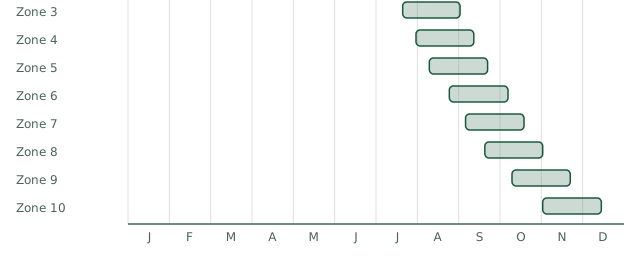
The windows below are timed off frost dates rather than the calendar — the same job happens more than a month apart across the country.
If you are removing it — fall is the most effective window
Penn State finds fall applications often the most effective on white clover, and notes regrowth sometimes follows spring treatment.
| USDA zone | Window |
|---|---|
| Zone 3 | July 21 – September 1 |
| Zone 4 | July 31 – September 11 |
| Zone 5 | August 10 – September 21 |
| Zone 6 | August 25 – October 6 |
| Zone 7 | September 6 – October 18 |
| Zone 8 | September 20 – November 1 |
| Zone 9 | October 10 – November 21 |
| Zone 10 | November 2 – December 14 |
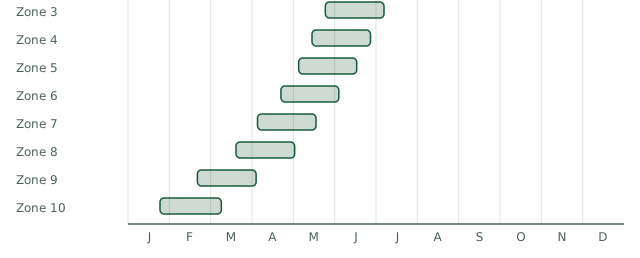
If you are keeping it — one window to sow clover is spring
Micro-clover and white clover can be sown into an existing lawn in spring; Illinois Extension allows early spring to late summer, and Minnesota's bee-lawn guidance prefers late fall. Skip weed preventers on areas you are sowing with clover unless the exact label explicitly permits clover at seeding. Mesotrione products sold for grass seeding, including Tenacity and Scotts Built For Seeding, control clover; grass-seeding permission does not cover clover. If already treated, follow that product's reseeding directions before sowing.
| USDA zone | Window |
|---|---|
| Zone 3 | May 25 – July 6 |
| Zone 4 | May 15 – June 26 |
| Zone 5 | May 5 – June 16 |
| Zone 6 | April 22 – June 3 |
| Zone 7 | April 5 – May 17 |
| Zone 8 | March 20 – May 1 |
| Zone 9 | February 20 – April 3 |
| Zone 10 | January 25 – March 8 |
The windows in each table above are zone-level approximations from long-term freeze normals. A hardiness zone measures winter cold rather than frost dates, so check your own local dates — and where the job is driven by soil temperature, let that have the final say.
Set those windows against your own frost dates
The table above is a zone average. Enter your ZIP for the NOAA freeze normals of the station we match to it — first fall freeze and last spring freeze both — free, no signup required.
Free · no signup · NOAA 1991–2020 normals
Is it bad, why it spreads, and the home remedies
- Is clover bad for my lawn?
- Agronomically, clover is not usually bad for a lawn: it fixes nitrogen and returns some to the soil. It was historically included in some lawn seed mixtures, and Illinois notes it was common in lawns before 1950s broadleaf herbicides, which often damaged or killed it. Whether it is a weed is largely a preference. The real arguments against it are bees where people with sting allergies play, patchiness, and, for microclover, poor heat and drought tolerance.
- Why is clover taking over my lawn?
- Clover most often takes over a lawn because nitrogen is low. It makes its own through bacteria in its root nodules, so where the soil is short the grass slows and clover does not; Penn State finds it very prevalent in under-fertilized lawns in full sun. Minnesota Extension adds compaction and drought stress as possible signals. A soil test checks pH and nutrients, though a routine test may not report nitrogen, so read it with how the lawn has been fed. Feeding the grass properly shifts the balance back without herbicide.
- How do I get rid of clover in my lawn?
- To get rid of clover, treat in fall with a product labeled for your grass that controls clover: Rutgers rates triclopyr most effective, and dicamba, fluroxypyr, quinclorac and MCPP also work, while 2,4-D alone is weak on it. Expect a possible second application four to six weeks later. Mow the flowers off before treating so bees are not foraging, then overseed the gaps once the label's seeding interval has passed.
- Will vinegar or dish soap kill clover?
- Vinegar and dish soap act only on the foliage they touch, so clover's roots and creeping stems survive and it regrows, and vinegar strong enough to burn the clover also burns the grass it lands on. If you want a non-traditional option, Rutgers research found repeated applications of chelated iron controlled white clover; it is still a registered product with a label to follow. Feeding the grass is the simplest no-herbicide route.
- Should I plant clover in my lawn on purpose?
- Planting clover on purpose is a reasonable choice: it adds nitrogen, may save a feeding a year, and flowers for pollinators. Sow microclover or white clover lightly for an even stand rather than patches, in spring or another window your local extension recommends. Understand the trade first: most lawn broadleaf herbicides will kill it, so you will rely mainly on hand weeding, and microclover struggles in heat and drought.
Where this guidance comes from
The university extension and public-agency publications listed here back specific statements on this page. Each publication says which statement it backs, so you can check the statement rather than take it on trust. Where a product label or your local extension office disagrees with anything here, follow the label or the extension office.
- Dutch white clover
University of Minnesota Extension
Clover can indicate low nitrogen, compaction and drought stress and is reduced by feeding; fall treatment works best, and 2,4-D alone is ineffective on it.
- Lawn and Turfgrass Weeds: White Clover
Penn State Extension
Clover is most common in under-fertilized, sunny lawns, its seed stays dormant in soil for long periods, fall treatment is the most effective, and dicamba, fluroxypyr and quinclorac control it (clopyralid is not for residential lawns).
- White Clover in Lawns
UMass Amherst Center for Agriculture, Food, and the Environment
Clover is a nitrogen-fixing legume, and its flowers draw bees, a real concern for people sensitive to stings.
- Microclovers making a comeback as lawns grow in biodiversity
Illinois Extension
Clover was common in lawns before 1950s broadleaf herbicides, which often damaged or killed it; microclover does not tolerate high heat and drought, most lawn broadleaf herbicides kill it, and it is sown from early spring to late summer.
- Clover
University of Maryland Extension
White clover was once included in turfgrass seed mixes, and it returns fixed nitrogen to the soil.
- Lawns and Microclover
University of Maryland Extension
Microclover blends evenly with tall fescue and bluegrass and may save one nitrogen application a year, but does not tolerate high heat and drought, dies back in winter, needs reseeding, is killed by most broadleaf herbicides, and draws bees.
- Broadleaf Weed Control in Cool Season Lawns (FS385)
Rutgers New Jersey Agricultural Experiment Station
2,4-D does not control white clover well, triclopyr is most effective and MCPP also works, a second application four to six weeks later may be needed, chelated iron controlled clover in Rutgers research, and keeping clover means hand weeding or 2,4-D alone.
- White Clover (HGIC 2324)
Clemson Cooperative Extension
Clover fixes nitrogen and can indicate inadequate fertility; Clemson rates standalone triclopyr for tall fescue and zoysia only, with some combination products also labeled for zoysia and bermuda; three-way products avoid green-up and heat above 90°F, and seeding waits at least three weeks after treatment.
- Planting and maintaining a bee lawn
University of Minnesota Extension
For a bee lawn that includes clover, late fall is the preferred seeding time and spring the second-best.
- Ecolawn: Less work and water
Oregon State University Extension
In western Oregon's summer-dry climate, clover is counted as drought-tolerant and green in summer.
