
Peak in summer
PGR for Bermuda Grass: Primo Maxx Schedule, Rates, and GDD Timing
A plant growth regulator (PGR) slows Bermuda's vertical growth. Under good growing conditions, the Primo Maxx label describes roughly 50% growth suppression for about four weeks. Timing needs to match the product, rate, turf and conditions. Growing degree days can help track heat between applications, but neither a heat total nor a calendar date alone establishes that another treatment is appropriate.
The system, step by step
- Step 1
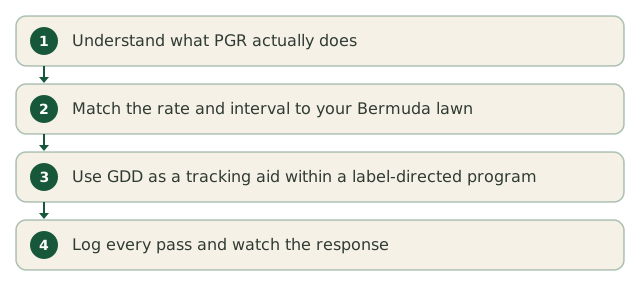
Understand what PGR actually does
Primo Maxx (trinexapac-ethyl) is a Type II regulator: it blocks late-stage gibberellic-acid synthesis, the hormone that drives cell elongation and vertical growth. Under good growing conditions, the Primo Maxx label describes roughly 50% growth suppression for about four weeks. Effects on density, color and rooting vary with grass, rate and conditions and are not guaranteed. It's not a weed killer or a fertilizer, so it pairs with — never replaces — a sound feeding program.
- Step 2
Match the rate and interval to your Bermuda lawn
Choose the label-directed rate for your Bermuda type, use site, mowing height and turf condition. Select the rate and interval together, including any applicable reduced-rate program or condition-specific adjustment; being new to a product is not by itself a reason to halve the rate. Calibrate the sprayer to apply the chosen rate evenly. If your sprayer uses 1–2 gallons of water per 1,000 sq ft, confirm that this meets your product's coverage directions for the application method; it is not a universal PGR carrier requirement. Add a surfactant or marking dye only when compatible with the product's directions.
Plant growth regulators are rate-sensitive — too much can discolor or stunt the lawn. Always read and follow the product label — it is the legal authority on rates, timing, and safety. These windows are regional estimates, not a prescription; defer to the label and your local extension office.
- Step 3
Use GDD as a tracking aid within a label-directed program
Temperature affects trinexapac-ethyl response, and GDD has been useful in studied reapplication programs. Kreuser and Soldat's 2011 creeping-bentgrass putting-green study found a 200 GDD program using a 0°C base more consistent in clipping-growth suppression at the tested rates than the four-week program tested there. That is not a universal Bermuda recommendation. Warm-season studies have used different bases and specific rates, mowing heights and endpoints; their results do not validate YardLedger's home-lawn targets. Follow the applicable product label, including any calendar restrictions, and consider observed turf response. Rebound growth is not inevitable, and GDD tracking does not guarantee its prevention.
- Step 4
Log every pass and watch the response
Record the product, rate, date and conditions at each application and note the turf's response over time. Review that history alongside the applicable label when considering another application. Appearance alone does not establish that growth regulation has ended.
The system that runs it
How YardLedger handles it
Great lawns are logged. YardLedger is the system behind the result: see how it all fits together.
- PGR tracking targets
- YardLedger tracks local-weather heat against a selected PGR target. Its default and height-adjusted targets are heuristics, not validated treatment intervals for your product and lawn. Reaching a target is a prompt to review the label and turf response, not proof that another application is due. (Available on paid plans.)
- PGR cadence log
- Log each PGR application with its product, rate and date, and compare that history with your recorded turf response when reviewing the next application.
- Product garage with rates & history
- Keep product details and application history together so you can review what was applied. A saved rate or past interval does not establish that repeating it meets the current label or lawn conditions.
Start from a schedule built for your yard
An enthusiast lawn program sits on top of the basics done on time. Enter your grass type and ZIP in the free schedule generator for the month-by-month foundation — no signup required.
Open the schedule generatorA reminder when the season’s next job is due
We'll email you about three weeks before this ZIP's normal first freeze — while irrigation contractors still have slots, and before the backflow preventer is the part that freezes.
The blow-out reminder counts back from your metro's NOAA 1991–2020 median first freeze, not this year's forecast — a normal year, give or take a couple of weeks. Add your address and the reminder follows the live forecast for your own yard, with the checklist built around the zones and shut-offs you've mapped.
Questions on the way there
- How often should I apply Primo Maxx to Bermuda?
- To decide how often to apply Primo Maxx to Bermuda, use the applicable product label for the rate, turf and site, and consider observed turf response. There is no single GDD total or fixed summer-day interval established here for every Bermuda lawn. GDD can help track heat between applications, but YardLedger's default and height-adjusted targets are heuristics; they do not establish treatment due dates or guarantee that rebound growth will be prevented. A label-directed calendar program is not inherently invalid.
- What does PGR do to a lawn?
- A plant growth regulator (PGR) such as trinexapac-ethyl slows vertical growth by interfering with gibberellic-acid synthesis, so the lawn needs mowing less often. Under good growing conditions, the Primo Maxx label describes roughly 50% growth suppression for about four weeks. It's rate-sensitive, so apply the label rate for your grass and height of cut.
- Will PGR hurt my lawn?
- Whether a PGR hurts a lawn depends on the product, rate, turf and conditions; a single application rate is not the whole label. Follow all applicable label directions and review your application history before another pass. Too much can bronze or yellow the lawn. A GDD target does not establish that regulation has ended or protect against overlapping applications.
Where this guidance comes from
The university extension and public-agency publications listed here back specific statements on this page. Each publication says which statement it backs, so you can check the statement rather than take it on trust. Where a product label or your local extension office disagrees with anything here, follow the label or the extension office.
- Plant Growth Regulators for Fine Turf (2016 Pest Management Guide)
Clemson University Turfgrass Program
Trinexapac-ethyl is a leaf-absorbed Type II regulator that interferes with gibberellic-acid production, the hormone behind cell elongation and vertical growth.
- Plant Growth Regulators
Cornell Turfgrass Program
Cornell describes reapplying on a consistent physiological interval, such as growing degree days, as a way to suppress growth evenly and limit rebound; this page treats GDD as a tracking aid alongside the product label, not a guarantee.
