
Every lawn
Lawn Soil Test: How to Take One, and What the Numbers Mean
To test lawn soil, follow your lab's instructions: usually about eight to ten cores taken across the area, to the depth the lab asks for, mixed in a clean plastic bucket. Send it to your state extension lab. Read pH first, then act on phosphorus and potassium as recommended; a soil test can't forecast a season's nitrogen.
Most lawn fertility advice, including YardLedger's, comes with the same hedge: a soil test would tell you. That is because the two things that decide whether fertilizer works can't be seen from above ground. Soil pH controls whether nutrients already in the soil are available to the grass, and phosphorus and potassium levels decide whether adding more does anything. A state extension lab's test is inexpensive, and it tells you whether to lime and whether phosphorus or potassium is needed at all. Often the answer is that nothing is needed.
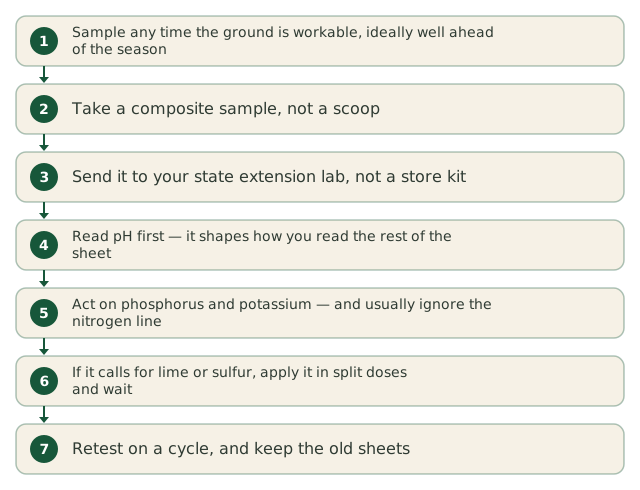
From sampling to acting on the results
- Step 1
Sample any time the ground is workable, ideally well ahead of the season
Labs accept samples year-round. UGA calls fall the most desirable time, because soil is usually dry and easy to get at, and Clemson suggests sampling a couple of months before the main fertilizing season so any lime has time to react. If you fertilized or limed recently, wait: Virginia Tech says at least two months, and your lab may set its own interval. If the soil is too wet to dig, NC's state lab notes, it is too wet to sample.
- Step 2
Take a composite sample, not a scoop
Follow your lab's instructions, because protocols differ. Most ask for about eight to ten cores taken at random across the area; Minnesota's lab asks for four to six, and Purdue suggests ten to fifteen. Depth varies too: the University of Minnesota lab asks for 0–3 inches under established grass and 0–6 under new grass, while Penn State and UGA use 4 inches. Scrape off thatch and live plant material before you dig, then mix the cores in a clean plastic bucket. Sample front and back separately if they were built or treated differently, and keep any trouble spot as its own sample, because blending it into the average hides it. Tell the lab which grass you grow.
Use a plastic bucket and clean tools. Clemson warns that pesticide or fertilizer residue on sampling tools gives misleading results, and NC's state lab warns that brass, bronze and galvanized tools or buckets can contaminate the sample.
- Step 3
Send it to your state extension lab, not a store kit
A land-grant university or state lab's test is the one worth having. Panels differ: pH, phosphorus and potassium are the usual core, while organic matter, buffer pH (often run only when the soil is acid enough to need lime) and cation exchange capacity are standard at some labs and optional at others. Purdue notes that cation exchange capacity describes how well the soil holds nutrients and can't be changed with fertilizer, so read it as context. Labs also use different chemical extractants, so phosphorus numbers don't carry from one lab to another; stay with one lab and read results against its own low, medium and high ratings. Store kits are rough at best: in SDSU's comparison they put pH within about a unit of the lab, which is enough to change a liming decision, and estimated phosphorus and potassium inconsistently.
- Step 4
Read pH first — it shapes how you read the rest of the sheet
The target depends on the grass. Purdue treats 6.0 to 7.5 as needing no adjustment, and UGA's table puts several Southern grasses at 5.5 to 6.5. Centipede is the exception to know: Clemson says it grows best at 5.5 to 6.0, and NC's state lab advises no lime at pH 5.5 or above and, if a report that didn't know the grass is centipede calls for lime below 5.0, applying only half of it. Bahiagrass also prefers acid soil. Direction matters as well as the number. As pH falls, iron, manganese and zinc become more available, and manganese can reach toxic levels in strongly acid soil, while molybdenum becomes less available; above neutral those micronutrients lock away. That is why yellowing on high-pH soil, especially centipede and bahia, is often an iron shortage rather than a nitrogen one, though nematodes can look similar. Purdue adds that lowering the pH of naturally alkaline soil with sulfur is often impractical, so there grass choice and targeted nutrients matter more than chasing the number.
- Step 5
Act on phosphorus and potassium — and usually ignore the nitrogen line
Phosphorus and potassium stay put in soil long enough to be worth measuring, so the report tells you something real. In some regions established lawns rarely test low: Purdue says phosphorus deficiency is rarely seen in established Indiana turf except on very high-pH soil, and potassium shortages are mostly on sandy soils. Nitrogen is the opposite. Purdue states there is no reliable soil test for it, because it moves and changes too quickly, so nitrogen is budgeted by grass and season rather than by test, and planned at about 1 lb per 1,000 sq ft or less per feeding (a conservative default, not a universal limit). Some labs, Minnesota's among them, base a nitrogen recommendation on organic matter and what you grow rather than on a nitrogen reading.
Some states restrict phosphorus on lawns. In Minnesota, for example, a home lawn may get phosphorus only if a test by a state-approved lab or method from the last three years shows a deficiency or a new lawn is being established, which makes the test the legal basis for applying it. Local fertilizer rules can be stricter than this and can override it: several states and counties set a lower per-application limit, cap the soluble (quick-release) fraction separately, require a share of slow-release nitrogen, or ban applications outright during a seasonal blackout. Check your state or county rules before you spread. Always read and follow the product label — it is the legal authority on rates, timing, and safety. These windows are regional estimates, not a prescription; defer to the label and your local extension office.
- Step 6
If it calls for lime or sulfur, apply it in split doses and wait
Lime is slow: Clemson notes pelletized limestone takes several months to dissolve and change pH. Purdue says applying it after core aeration speeds the change. Split large amounts: UGA splits anything over 50 lb per 1,000 sq ft into two applications four months apart. Sulfur, for lowering pH, goes on in smaller doses: Clemson caps it at 5 lb of pelletized sulfur per 1,000 sq ft per application on centipede, only below 80°F, watered in right away, and no more than 10 lb a year with at least a month between applications. Overshooting is harder to reverse than undershooting, so retest before adding more. Purdue's rule is not to lime at all unless the test recommends it, and never with hydrated lime on a lawn.
- Step 7
Retest on a cycle, and keep the old sheets
Intervals vary by source. UGA retests lawns every two to three years once fertility is established, Penn State every two to three years on sandy soil and three to four on clay, Purdue every three to five, and Clemson recommends sampling every year. Test more often while something is changing: during a pH correction (Clemson rechecks centipede after about three months), through establishment or renovation, or when a problem isn't explained. Keep the reports. One test is a reading; several from the same lab show whether pH and nutrient levels are actually moving.
Got the numbers — now what goes down, and when?
A soil test reports your pH and the nutrient levels your lab measures, rated on that lab's own scale. Enter your grass type and ZIP in the free schedule generator for the month-by-month feeding plan it fits into, with the nitrogen already budgeted for your grass — no signup required.
Open the schedule generatorWant the next seasonal job flagged for you?
We'll email you about three weeks before this ZIP's normal first freeze — while irrigation contractors still have slots, and before the backflow preventer is the part that freezes.
The blow-out reminder counts back from your metro's NOAA 1991–2020 median first freeze, not this year's forecast — a normal year, give or take a couple of weeks. Add your address and the reminder follows the live forecast for your own yard, with the checklist built around the zones and shut-offs you've mapped.
Kits, timing, pH and the nitrogen line
- How often should I do a lawn soil test?
- Extension advice on testing a settled lawn ranges from every year to every five: UGA says two to three, Penn State two to three on sandy soil and three to four on clay, Purdue three to five, while Clemson recommends every year. Follow your own lab's advice. Test more often while something is changing, such as a pH correction or a renovation, because that is how you find out whether it is working.
- What pH should lawn soil be?
- The right soil pH for a lawn depends on the grass. Purdue considers 6.0 to 7.5 fine without adjustment, and several Southern grasses do well from about 5.5 to 6.5. Centipedegrass prefers about 5.5 to 6.0 and is sensitive to overliming: NC's state lab advises no lime at pH 5.5 or above. Bahiagrass also prefers acid soil. Tell your lab which grass you grow and use the target on its report.
- Are hardware-store soil test kits any good?
- Hardware-store soil test kits give a rough pH reading at best. SDSU Extension found kits put pH within about a unit of the lab, which can still swing a liming decision, and estimated phosphorus and potassium inconsistently. They also give no recommendation calibrated to your region. Don't buy lime or fertilizer on a kit reading; your state extension lab charges little for the version that answers the question.
- When is the best time to take a soil sample?
- You can take a soil sample any time the ground isn't frozen or saturated. UGA calls fall the most desirable time because soil is dry and accessible, and Clemson suggests sampling a couple of months before you plan to fertilize so any lime has time to act. After fertilizer or lime, Virginia Tech says to wait at least two months. Use clean tools and a plastic bucket; Clemson warns pesticide or fertilizer residues give misleading results.
- Does a soil test tell me how much nitrogen to apply?
- A soil test does not tell you how much nitrogen to apply over the season. Purdue states there is no reliable soil test for nitrogen, because it moves and transforms too fast for a snapshot to predict what will be there when the grass needs it. Some labs give a nitrogen recommendation based on organic matter and what you grow instead. The season's nitrogen is budgeted from your grass type, region, goals, whether you return clippings, and how you irrigate — with a conservative planning default of about 1 lb per 1,000 sq ft in any one feeding, not a universal limit. Local fertilizer rules can be stricter than this and can override it: several states and counties set a lower per-application limit, cap the soluble (quick-release) fraction separately, require a share of slow-release nitrogen, or ban applications outright during a seasonal blackout. Check your state or county rules before you spread.
Where this guidance comes from
The university extension and public-agency publications listed here back specific statements on this page. Each publication says which statement it backs, so you can check the statement rather than take it on trust. Where a product label or your local extension office disagrees with anything here, follow the label or the extension office.
- Soil Testing
Penn State Extension
A lawn sample is a composite of cores taken at random and mixed in a plastic bucket, and retesting runs every two to three years on sandy soil and three to four on clay.
- Soil Testing for Home Lawns, Gardens and Wildlife Food Plots (Circular 896)
University of Georgia Cooperative Extension
Samples can be taken any time, fall is the most convenient, thatch is cleared first, and an established lawn is retested every two to three years.
- Soil Testing (HGIC 1652)
Clemson Cooperative Extension
Sample a couple of months before the fertilizing season with clean tools, since residues mislead; Clemson recommends yearly sampling; pH governs nutrient availability, and lime takes months to change it.
- A Spreadsheet-Based Calculator for Lawn Fertilizer and Lime Applications in Virginia (SPES-40)
Virginia Cooperative Extension
After a fertilizer or lime application, wait at least two months before taking a new soil sample.
- Lawn & Garden Soil Test Request Form (2026)
University of Minnesota Soil Testing Laboratory
Sampling depth and core count are set by the lab (0–3 inches under existing grass, 0–6 under new, four to six cores at UMN), trouble spots are sampled separately, and nitrogen advice comes from organic matter and what you grow.
- Soil Testing for Lawns (AY-18)
Purdue Extension
There is no reliable soil test for nitrogen; established Indiana turf rarely lacks phosphorus or potassium; pH 6.0–7.5 needs no adjustment; lime only when recommended, never hydrated lime, and faster after aeration; and sulfur rarely corrects alkaline soil.
- Note 4: Lawns, Gardens and Ornamentals
NC Department of Agriculture & Consumer Services
Tell the lab it is centipede: no lime at pH 5.5 or above, half a non-centipede recommendation below 5.0, and high-pH yellowing is often iron deficiency, though nematodes look similar.
- Collect Samples (homeowners)
NC Department of Agriculture & Consumer Services
Use clean plastic, never brass, bronze or galvanized tools or buckets, which can contaminate the sample, and don't sample soil too wet to dig.
- Centipedegrass Yearly Maintenance Program (HGIC 1215)
Clemson Cooperative Extension
Centipede grows best at pH 5.5–6.0; sulfur goes on at no more than 5 lb per 1,000 sq ft per application below 80°F, is watered in, totals no more than 10 lb a year, and pH is rechecked after about three months.
- Turfgrass Fertility: Soil Texture, Organic Matter, Aeration, and pH (C1058-1)
University of Georgia Cooperative Extension
Several Southern lawn grasses do best around pH 5.5–6.5, and lime above 50 lb per 1,000 sq ft is split into two applications four months apart.
- Minnesota Statutes §18C.60 — Phosphorus turf fertilizer use restrictions
Minnesota Legislature (Office of the Revisor of Statutes)
Minnesota bars phosphorus on turf except where a test by an approved lab or method from the last three years shows a deficiency, a new lawn is being established in its first season, or (for golf courses) under licensed direction.
- Are Cheap Home Garden Soil Test Kits Accurate?
South Dakota State University Extension
Store kits put pH within about a unit of the lab but estimated phosphorus and potassium inconsistently.
- What is the best soil test option for phosphorus?
University of Minnesota Extension
Labs use different extractants, so phosphorus numbers from one lab do not carry directly to another.
- Micronutrients in Mississippi Soils and Plant Nutrition (P3726)
Mississippi State University Extension
As pH rises, iron, manganese and zinc become less available and molybdenum more so, and manganese can be toxic in strongly acid soil.
- Bahiagrass for Florida Lawns (ENH6)
UF/IFAS Extension
Bahiagrass prefers acid soil and is prone to iron deficiency on high-pH soil.
