
Sprinkler winterization dates
When to Winterize Sprinklers in Denver, CO
In Denver, CO the first freeze normally arrives around October 9, which puts the blow-out window at roughly September 11–27 — start about four weeks out and be finished by September 27. Denver, CO's deadline is a fixed 12-day planning buffer before the average date, because about half of years freeze before it.
The backflow preventer sitting above ground outside your house in Denver, CO is damaged by the first real freeze rather than the tenth.
- Winterize between
- September 11–27
- Average first freeze
- October 9
- Planning buffer from: September 27
- Spring planning checkpoint
- May 17
- Median last freeze May 5, plus a margin — half of years freeze later than the median. This is not a freeze-free date; check current conditions.
The freeze date above is NOAA's 1991–2020 normal for the station that represents this city, so it describes a typical year rather than this one. Elevation, cold-air drainage and how built-up your street is all move the real date at your address — watch the forecast as the window opens, and act on the first hard freeze in it rather than on the date.
For Denver, CO, long-term freeze normals are the ceiling for a static page. YardLedger can alert you to forecast freeze risk when your location, season and notification settings qualify. Forecasts and delivery can change; keep checking local conditions. Get my freeze reminder
From the long-term NOAA freeze normals for Denver.
The window against the freeze band
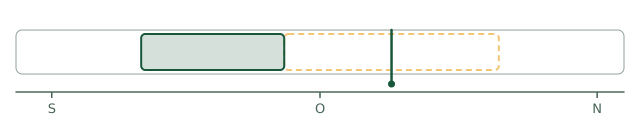
- Blow-out window — September 11–27
- Planning band (median ± 12 days) — from September 27
- Median first freeze — October 9
Why September 11–27, and not later
A median is not a deadline
Half of Denver, CO's years freeze earlier than October 9, so this page sets a 12-day buffer before it. Scheduling the work to finish on the average date means missing it every other year.
The backflow device goes first
Buried irrigation pipe has soil buying it time. The backflow preventer is brass, above ground and full, so around Denver, CO it can be damaged by the first real freeze rather than the tenth — and it is the most expensive part on the system.
Contractors book out
If you are hiring out sprinkler winterization, the few weeks before the first freeze are the busiest of the irrigation year in Denver, CO. Booking at the start of the window rather than the end is the difference between a date you chose and one you were given.
When is your first freeze?
The winterization dates on this page are Denver, CO's normals. Your yard's can differ — enter your ZIP for the NOAA station we match to it, which may not be the one anchoring Denver, CO. Free, no signup required.
Free · no signup · NOAA 1991–2020 normals
How Denver, CO compares
Of the 68 metros we publish winterization dates for, Denver holds the 11th-earliest median first freeze — 10 typically freeze sooner, 57 hold out longer, and Denver lands 18 days ahead of the middle of that list. The closest published dates on either side of Denver belong to Colorado Springs, CO (October 8) and Madison, WI (October 10) — winterization advice written for either transfers here almost unchanged, which is not true of a national average.
Between the median first freeze (October 9) and the median last spring freeze (May 5), Denver's freeze season runs about 208 days — call it 30 weeks with the system down, more than half the year. That arithmetic is behind both ends of this page: the blow-out window is the fall edge of it, and the spring-startup date is the other, pushed past Denver's median because half of years freeze later still — leaving roughly 157 days of running season between startup and the next blow-out.
Within Colorado, Colorado Springs typically freezes 1 day earlier (October 8). If your address sits nearer one of those metros, its page is the better anchor. The statewide page, by design, follows the earliest of them rather than the average.
What to do inside that window
The sprinkler winterization field sequence below keeps the step numbers of the full winterization guide — each step opens its full detail there, including which method suits your system.
- Step 2Confirm the equipment and method before starting
- Step 3Shut the irrigation main off and stop the controller
- Step 4Plan the backflow drainage and air isolation
- Step 5Choose the method the installation supports
- Step 6If approved for this system, use regulated air with an open zone
- Step 7Stop air, relieve pressure, then complete drainage and storage
- Step 8Finish with the small stuff that also freezes
Professional blow-out
$50–250
If you skip it
$170–$2,500+
DIY pressure ceiling
50 PSI
What it costs, in detail · No compressor? · Draining the backflow preventer
Shutoff questions
- When should I winterize my sprinkler system in Denver, CO?
- Winterize a sprinkler system in Denver, CO between about September 11–27, finishing by September 27. The average first fall freeze in Denver, CO is around October 9, and about half of years freeze before it — so the deadline is set a fixed 12 days earlier, a planning buffer rather than a measured early-freeze date. The freeze date above is NOAA's 1991–2020 normal for the station that represents this city, so it describes a typical year rather than this one. Elevation, cold-air drainage and how built-up your street is all move the real date at your address — watch the forecast as the window opens, and act on the first hard freeze in it rather than on the date.
- Is it too late to blow out my sprinklers in Denver, CO?
- Past September 27, Denver, CO is into the window where a hard freeze can arrive at any time, so blow out the sprinklers now rather than waiting for a better weekend — but if a hard freeze has already been through, do not pressurise the system to check it. Drain what you can, leave it off for the winter, and inspect for damage at spring startup instead.
- When is the first frost in Denver, CO?
- The long-term normal for the first 32°F freeze in Denver, CO is around October 9; the planning buffer on this page ends 12 days earlier, at September 27. A light frost will not usually reach buried pipe; whether a colder night does depends on how long it lasts and on how deep and well covered the pipe is, so no single temperature decides it. An exposed backflow preventer is vulnerable well before that. For calendar context, that median ranks 11th of the 68 metros we publish dates for.
- What does it cost to winterize a sprinkler system in Denver, CO?
- A professional blow-out in Denver, CO typically runs $50–250 depending on zone count. Freeze repairs typically run $170–$2,500+, with the backflow preventer the priciest common casualty. If you are doing it yourself, stay at or below 50 PSI and any lower component-manufacturer limit, only where the equipment permits air. If the models, drain paths or air requirements are unknown, use qualified irrigation or backflow service first. This cap does not establish a safe procedure for an unidentified system.
- When can I turn the sprinklers back on in Denver, CO?
- The last spring freeze in Denver, CO normally passes around May 5, but that is a median — half of years freeze later than it. Use May 17 as a planning checkpoint, not a freeze-free date. Check the current forecast and local conditions; postpone startup while freezing remains a concern. Follow the exact installation and backflow model’s filling and air-bleeding instructions; valve sequences differ by model. Use qualified irrigation or backflow service if those instructions are unknown. All told, the system sits out roughly 30 weeks of the year here.
