
Winter color over dormancy
How to Overseed Zoysia Grass with Ryegrass for Winter
Most extension guidance advises against winter overseeding a home zoysia lawn: it is slow out of dormancy, and ryegrass that overstays competes with it well into the season. If you do it anyway, sow ryegrass once nights settle into the 50s°F and soil falls through about 70°F, verticut the dense canopy first, and force the ryegrass out early in spring.
Zoysia goes fully dormant and straw-brown over winter — that is normal and healthy, not a problem to fix. Overseeding it with ryegrass is a purely cosmetic choice: you sow a temporary cool-season grass over the top just as the lawn slides into dormancy, get a green winter, and then get it back out again before spring. It is real extra work through the off-season, and done badly it delays green-up, so it is worth being clear that you are trading winter color for spring vigor — a trade plenty of Southern lawns are happy to make, and plenty of others correctly skip.
Start here: winter overseeding is generally NOT recommended on a home zoysia lawn, and most extension guidance says so. Bermuda is the base lawn this job is designed around. Zoysia is the slower of the two at every stage that matters: slower out of dormancy in spring, and slower to fill in once it is growing, so ryegrass that overstays does not just delay green-up — it competes with a grass that takes much of the season to close the ground it lost. Its canopy is also denser and thatchier than bermuda's, which makes seed-to-soil contact the hard part of the job rather than a formality. It is done, and done successfully, but treat it as an advanced exception rather than a normal option: check it against your own local extension guidance first, be ready to force the transition early and hard in spring, and understand that "skip it and enjoy a dormant lawn" is the recommended answer for zoysia in a way it is not for bermuda.
For the rest of the year, see the Zoysia lawn care schedule by month & zone.
When to overseed zoysia grass
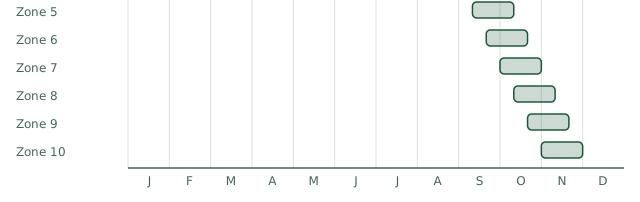
For a winter ryegrass overseed, watch the lawn, not the calendar. Sow once nighttime lows are settling into the 50s°F, soil at a few inches has fallen through about 70°F, and the base lawn has visibly slowed — growth easing off, color going flat. That is the base lawn handing over. Seed before it and you are sowing into a lawn that is still growing and will out-compete the seedlings; seed well after it and the ryegrass is not established when real cold arrives.
| USDA zone | Sow | Start the hand-back |
|---|---|---|
| Zone 5 | mid-September to early October | mid-March |
| Zone 6 | late September to mid-October | mid-March |
| Zone 7 | early October to late October | early March |
| Zone 8 | mid-October to early November | mid-February |
| Zone 9 | late October to mid-November | early February |
| Zone 10 | early November to late November | mid-January |
The zone rows in this table are the usual arrival of the ryegrass sowing conditions, not a deadline. They run later toward the Gulf and the desert Southwest, which is why this window is set by temperature rather than by your first frost date — in the mildest zones a hard freeze may not arrive until January, long after the lawn has stopped growing and the seeding window has closed.
The hand-back column is when Zoysia typically *begins* breaking dormancy, which is when the ryegrass has to start coming out — not when it has to be gone. Green-up then runs for several more weeks. Waiting for it to finish is the mistake: ryegrass still standing over a lawn that is trying to wake up is what produces a thin, late green-up.
Or find your state
- Alabama
- Arizona
- Arkansas
- California
- Florida
- Georgia
- Louisiana
- Mississippi
- Nevada
- North Carolina
- Oklahoma
- South Carolina
- Tennessee
- Texas
- Virginia
Each state page lists its metros with their own windows. All metros & states.
Has your zoysia grass handed over yet?
The winter-overseeding table on this page is per-zone, which is an average over a band hundreds of miles wide — and the year matters as much as the place. Enter your ZIP for the live modeled soil temperature where you are, and whether your zoysia grass has slowed enough to seed into — free, no signup required.
Free · no signup · live modeled soil temperature
Perennial or annual ryegrass?
Perennial Ryegrass
The default for a home lawn you care about the look of.
Perennial ryegrass is finer-bladed, darker, and denser than annual ryegrass, so the winter lawn actually looks like a lawn rather than a cover crop. It costs more per bag and it does not die as obligingly in spring — you have to manage it out — but for a front yard it is worth it.
Perennial Ryegrass care schedule →Annual Ryegrass
The cheap option — and the one that leaves on its own.
Annual ryegrass is coarser, lighter green, and clumpier, but it germinates in days, costs a fraction as much, and reliably dies out in the first real heat, which makes the spring transition mostly automatic. Common on athletic fields, large areas, and anywhere color matters more than texture.
Annual Ryegrass care schedule →Seeding over zoysia grass, start to finish
- Step 1
Pick your ryegrass first — perennial or annual
Perennial ryegrass is finer, darker, and denser, and it is what you want if the lawn is on show; annual ryegrass is coarser and lighter but far cheaper and dies out on its own in the first real heat, which makes spring easier. Decide before you buy, because it changes both the price and how much work the spring transition is.
- Step 2
Wait until the base lawn is on its way out
Sow ryegrass over Zoysia once nights are settling into the 50s°F and soil a few inches down has fallen through about 70°F — the point where Zoysia stops pushing growth and starts going flat. That is the signal, not a date: it lands in October across most of the South and in November on the Gulf Coast and in the low desert. Going early is the classic mistake — an eager overseed is just ryegrass fighting a lawn that is still growing and will win.
Do not time this off your first frost date. In the mildest winter-overseeding markets a hard freeze may not arrive until January, months after the lawn has stopped growing and the seeding window has closed.
- Step 3
Scalp it down and bag the clippings
Seed has to reach soil, and a dense warm-season canopy will hold it up off the ground. Drop the mower to the bottom of Zoysia's range — around 0.75" — over a couple of cuts rather than all at once, and bag everything. Rake or dethatch if there is a thick mat. The lawn will look rough for a week; it is going dormant anyway. Budget more time for this step than a bermuda guide would suggest: zoysia builds thatch readily and its canopy is dense enough that scalping alone often will not open the surface — on an established zoysia lawn, dethatching or a light verticut is usually the difference between seed that germinates and seed that sits on top and blows away.
- Step 4
Spread the seed and keep it moist as seedlings establish
Follow the overseeding rate on the bag — ryegrass at too heavy a rate gives you a thick, clumpy mat that is even harder to transition out in spring. Water lightly as needed to keep the seedbed moist without soaking it. This commonly needs daily watering, with several light waterings a day in warm, dry or windy weather.
Clemson's South Carolina guidance gives 2–3 a day until germination; Arizona's low-desert guidance gives 3–4 a day initially. These are regional examples, not a minimum or maximum for every lawn. Check the seedbed throughout the day: drying conditions may call for more frequent care, while rain that keeps it moist can reduce or replace irrigation. Germinating seed and young seedlings are vulnerable to drying, which can kill them.
Ryegrass can emerge quickly, but emergence is only the start of establishment. As the new ryegrass seedlings grow and root, gradually water more deeply and less often, keeping any slower-germinating grass in the mix supplied with moisture.
Follow the seeding rate on the bag — the seed label is the authority on coverage, and more seed is actively worse here.
- Step 5
Mow it and feed it lightly through winter
Winter overseeding leaves you a growing lawn in January, so you will be mowing when your neighbors are not — keep it in the ryegrass's normal range and do not let it get shaggy. Feed sparingly: enough to hold color, no more. Extra nitrogen mostly feeds the ryegrass, which then competes with Zoysia for nutrients, water and light as it breaks dormancy in spring.
Plan about 1 lb of nitrogen per 1,000 sq ft per feeding or less — a conservative default, not a universal limit. Local fertilizer rules can be stricter than this and can override it: several states and counties set a lower per-application limit, cap the soluble (quick-release) fraction separately, require a share of slow-release nitrogen, or ban applications outright during a seasonal blackout. Check your state or county rules before you spread. Always read and follow the product label — it is the legal authority on rates, timing, and safety. These windows are regional estimates, not a prescription; defer to the label and your local extension office.
- Step 6
Check the pre-emergent label before winter overseeding
Many fall pre-emergents can injure new ryegrass. Check the exact product label for both the existing Zoysia and the grass you are sowing, including the seed mixture, rate and seedling stage. If no permitted treatment fits, manage winter weeds after they appear, following the new-turf directions for any herbicide.
Most conventional pre-emergents can injure seedlings or prevent establishment. Before seeding treated ground, follow the exact product's reseeding interval for the rate used; waits are often months, not weeks. Before treating newly seeded grass, follow its separate waiting, mowing and establishment requirements. Use a product at seeding only when its label allows your grass species, seed mixture, rate and timing. For crabgrass prevention while seeding cool-season grass, mesotrione products with new-seeding directions are an option only for the existing turf and seed mixture that product lists. Species and timing differ by product, especially for fine fescue; avoid over-application, particularly with perennial ryegrass.
Always read and follow the product label — it is the legal authority on rates, timing, and safety. These windows are regional estimates, not a prescription; defer to the label and your local extension office.
- Step 7
Hand the lawn back in spring — on time
Spring transition is the step people skip, and it is the one that does the damage. As soil warms and Zoysia tries to break dormancy, the ryegrass is still there shading it and taking the water. Start mowing lower, stop feeding and watering the ryegrass, and let heat finish it off. Annual ryegrass mostly leaves on its own; perennial ryegrass often needs a chemical transition, which is a herbicide decision to make off the label. The trigger here is the same kind as the one you seeded on: act when Zoysia starts to green, not on a date.
Start earlier than feels necessary. Zoysia breaks dormancy slowly and unevenly, so the first green is a much weaker signal than bermuda's — by the time the lawn obviously looks like it is waking up, the ryegrass has already had several weeks of shading it, and zoysia's slow lateral fill means whatever thins out stays thin.
A slow transition means a late, thin green-up. If you use a transition herbicide, it must be labeled for zoysia grass. Always read and follow the product label — it is the legal authority on rates, timing, and safety. These windows are regional estimates, not a prescription; defer to the label and your local extension office.
Where a winter overseed goes wrong
- Overseeding too early, while the base lawn is still growing — the ryegrass competes with it instead of following it into dormancy.
- Applying a fall pre-emergent without checking its label for the existing turf, new ryegrass, seed mixture, rate and stage.
- Feeding the ryegrass hard over winter, which pushes it at the expense of Zoysia's spring green-up.
- Letting the ryegrass run deep into spring — the longer it holds on, the later and weaker the base lawn comes out of dormancy.
The pre-emergent trade is the one worth reading twice — fall pre-emergent timing, and when to skip it covers both sides of that decision.
Ryegrass over zoysia grass: what people ask
- When should I overseed zoysia grass with ryegrass?
- Overseed Zoysia grass with ryegrass once nights are settling into the 50s°F and soil a few inches down has fallen through about 70°F — usually October across most of the South, and November on the Gulf Coast and in the low desert. Earlier than that and the ryegrass competes with a base lawn that is still growing; much later and it is not established before real cold arrives. Do not work back from your first frost date: in the mildest overseeding markets the first freeze can fall in January, long after the right week has passed.
- When do I get the ryegrass back out?
- Take the ryegrass out of a Zoysia lawn as soon as the base lawn starts to break dormancy — not once it has finished. Stop feeding and watering the ryegrass, drop the mowing height, and let heat finish it. Annual ryegrass largely goes on its own in the first real heat; perennial ryegrass usually needs a chemical transition labeled for zoysia grass. Leaving it too long is the single most common way a winter overseed ends up costing more than it was worth. Always read and follow the product label — it is the legal authority on rates, timing, and safety. These windows are regional estimates, not a prescription; defer to the label and your local extension office.
- Perennial or annual ryegrass — which should I use?
- Perennial ryegrass is the pick for a lawn you care about the look of: finer, darker, denser. Annual ryegrass if you want cheap winter color over a large area and an easy spring — it is coarser and lighter, but it dies out on its own in the first real heat instead of needing to be transitioned out.
- Will overseeding hurt my zoysia lawn?
- Winter overseeding can hurt a Zoysia lawn, and the risk is almost entirely in spring rather than winter. Ryegrass left running too long shades and out-competes Zoysia exactly when it is trying to break dormancy, giving you a late, thin green-up. Done on time and transitioned out on time it is a cosmetic choice with a small cost; skipped in spring it is a real setback.
- Can I put down a fall pre-emergent if I overseed?
- A fall pre-emergent fits a ryegrass overseed only when the exact product label permits the existing turf and new ryegrass, seed mixture, rate and stage. Most conventional pre-emergents can injure seedlings or prevent establishment. Before seeding treated ground, follow the exact product's reseeding interval for the rate used; waits are often months, not weeks. Before treating newly seeded grass, follow its separate waiting, mowing and establishment requirements. Use a product at seeding only when its label allows your grass species, seed mixture, rate and timing. For crabgrass prevention while seeding cool-season grass, mesotrione products with new-seeding directions are an option only for the existing turf and seed mixture that product lists. Species and timing differ by product, especially for fine fescue; avoid over-application, particularly with perennial ryegrass. Always read and follow the product label — it is the legal authority on rates, timing, and safety. These windows are regional estimates, not a prescription; defer to the label and your local extension office.
- How much does the lawn need to be mowed over winter?
- A winter-overseeded lawn needs mowing more than you might expect — you have a live, growing cool-season grass through the coldest months, so you will be mowing while dormant lawns nearby are not. That off-season mowing is the real ongoing cost of a winter overseed, more than the seed.
- How much should I feed a winter-overseeded zoysia lawn?
- Feed a winter-overseeded Zoysia lawn lightly: enough to hold ryegrass color and no more — Zoysia runs on a 2–3 lb annual nitrogen budget per 1,000 sq ft, and a well-fed ryegrass competes harder with it at spring green-up. Plan each feeding at about 1 lb per 1,000 sq ft or less (a conservative default, not a universal limit). Local fertilizer rules can be stricter than this and can override it: several states and counties set a lower per-application limit, cap the soluble (quick-release) fraction separately, require a share of slow-release nitrogen, or ban applications outright during a seasonal blackout. Check your state or county rules before you spread. Always read and follow the product label — it is the legal authority on rates, timing, and safety. These windows are regional estimates, not a prescription; defer to the label and your local extension office.
The part that starts in spring
Seeding is the short half of the job. The winter overseed you sow in autumn is not finished until Zoysia is fully back the following spring — a stretch of off-season mowing, restrained feeding, and then a hand-back that has to happen while the base lawn is waking up, not after. Get the hand-back late and the cost is a thin, delayed green-up that lasts most of the summer, which is a far bigger deal than the winter color was. It is worth deciding in October whether you want to be doing this in March.
- Through winter — mow the ryegrass while the neighbors' lawns are dormant, and feed it only enough to hold color.
- As soil begins to warm — stop feeding the ryegrass entirely. Anything you put on it now is taken from Zoysia's green-up.
- At the first sign of green-up — drop the mowing height and cut back the water. This is the deadline that matters, and it moves with the weather.
- Once Zoysia is actively growing — the ryegrass should be gone. Annual ryegrass mostly leaves in the first real heat; perennial usually needs help.
Where this guidance comes from
The university extension and public-agency publications listed here back specific statements on this page. Each publication says which statement it backs, so you can check the statement rather than take it on trust. Where a product label or your local extension office disagrees with anything here, follow the label or the extension office.
- Pros and Cons of Overseeding Warm-Season Lawns (Turf Tips Newsletter, 10-3-11)
Mississippi State University Extension Service
Ryegrass is seeded once soil temperature comes down to around 70°F — the soil-temperature trigger this page's timing is built on.
- Overseeding Winter Grasses into Bermudagrass Turf (AZ1683)
University of Arizona Cooperative Extension
Overseeding too early, while it is still warm, favors the bermudagrass and keeps the winter grass from establishing — why this page waits for the season to cool.
- Your Florida Lawn in Winter
UF/IFAS Gardening Solutions
Ryegrass overseeding is a temporary winter lawn on dormant warm-season grass, sown once the weather cools in fall and fading out as temperatures rise in spring.
