
Before the first hard freeze
What Happens If You Don't Winterize Your Sprinkler System
If you don't winterize, water left in the system freezes, expands about 9% and splits whatever holds it — the backflow preventer first, then low spots in the lines, valve bodies and heads. Nothing looks wrong over winter because there is no pressure behind the cracks; you find out at spring startup, with repairs typically running $170–$2,500+.
Everything on an irrigation system that holds water is a sealed container, and water expands about 9% when it freezes. That is the entire mechanism. What makes it costly rather than merely annoying is the delay: a pipe that split in December looks completely normal in January, because there is no pressure behind it. You find out in April, when the system is turned back on and a lawn-wide sprinkler system becomes a lawn-wide leak.
Working through it
- Step 1
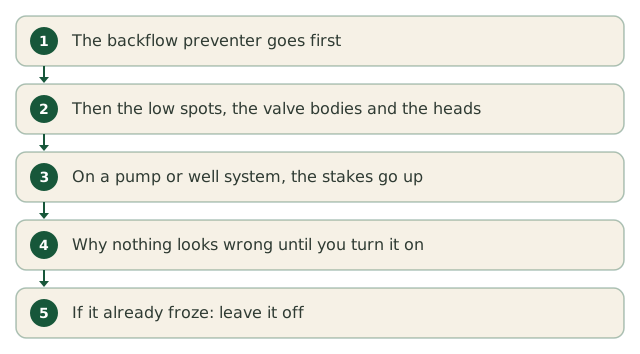
The backflow preventer goes first
An above-ground backflow preventer is brass and full of water. It has no soil insulating it and no way to drain itself, so it is damaged by freezes that never reach the buried pipe — often the first real cold snap of the season. It is also the most expensive single component on most residential systems.
- Step 2
Then the low spots, the valve bodies and the heads
Buried poly lateral lines split where water pooled at a low point. Valve bodies crack at the diaphragm chamber. Sprinkler head cans split along the barrel and the internal assemblies bind. Below-grade components survive longer than the backflow device because soil buys time, but a sustained hard freeze with no snow cover reaches them.
- Step 3
On a pump or well system, the stakes go up
A pump, its pressure tank and the above-ground plumbing around it are all exposed and all hold water, and they are considerably more expensive than a sprinkler head. If the system draws from a well or a pond rather than the municipal main, winterizing is not optional maintenance.
- Step 4
Why nothing looks wrong until you turn it on
A depressurised split in sprinkler pipe leaks nothing. The damage only announces itself when the system is pressurised again — which is why spring startup should be treated as an inspection rather than a flip of a switch, and why you re-pressurise slowly and watch the backflow device while the mains fill.
- Step 5
If it already froze: leave it off
Do not turn a sprinkler system that already froze back on to check. Shut it down, drain what you can reach, leave it depressurised through the rest of winter, and plan a careful startup in spring. Pressurising a cracked line finds the damage by flooding something.
A cracked backflow assembly can also be a cross-connection risk on a potable supply. If the device is visibly damaged, leave the irrigation main closed and have it replaced before the system is used.
When does your first freeze usually arrive?
The right sprinkler winterization method depends on your equipment, and the planning window depends on your location. Enter your ZIP for the NOAA freeze normals of the station we match to it — free, no signup required.
Free · no signup · NOAA 1991–2020 normals
Where this job usually trips people up
- What happens if you don't blow out your sprinkler system?
- Water left in a sprinkler system that is never blown out freezes and expands about 9%, splitting whatever contains it — the backflow preventer first, then low spots in the laterals, valve bodies and heads. Typical repairs run $170–$2,500+.
- Will one freeze ruin a sprinkler system?
- One sustained hard freeze is enough to destroy an above-ground backflow preventer. Buried pipe usually needs a longer or deeper freeze, especially with snow cover — but the expensive component is the exposed one.
- How do I know if my sprinklers froze?
- You usually cannot tell whether sprinklers froze until spring. Visible cracks or a split body on the backflow device are the one obvious tell. Everything else shows up on startup as a zone that will not pressurise, a soggy patch over a lateral, weeping valves, or heads that gurgle instead of popping up.
- Does it matter in a mild climate?
- Sprinkler winterization in a mild climate depends on whether you get real freezes rather than how often. Somewhere that freezes twice a winter still needs winterizing; somewhere that genuinely never drops below freezing does not. The ZIP frost tool answers which of those you are.
Get the reminder without scrolling back up
Enter your ZIP and we’ll set up the same reminder the ZIP tool higher on this page offers, timed to when it actually matters for your area.
Free · no signup · NOAA 1991–2020 normals
Check the instructions for your equipment
The equipment-manufacturer guides below explain the differences discussed here. Use the current instructions for your exact model, size and installation; an example for another device is not a procedure for yours. If you cannot verify them, use qualified service before connecting air or opening parts.
- FEBCO 765 winterization — IS-F-765-Winterization 2043 (2020), pages 1–2
- Zurn 950/950XL and 975/975XL freeze protection — Rev. C (July 2017)
- FEBCO 850/LF850 Small and 860/LF860 Small (½–2 in.) — 2344 (2023), pages 1–2
- Watts 800M4/LF800M4 — RP/IS-800M4 2409 (2024), Freeze Protection, page 2
- Rain Bird homeowner winterization guide — pressure and valve drainage, pages 3–6
- Hunter winterization guidance — component limits and air precautions
Where this guidance comes from
The university extension and public-agency publications listed here back specific statements on this page. Each publication says which statement it backs, so you can check the statement rather than take it on trust. Where a product label or your local extension office disagrees with anything here, follow the label or the extension office.
- Home Sprinkler Systems: Preparing Your Sprinkler System for Winter (Fact Sheet 4.719)
Colorado State University Extension
Water left in the system expands as it freezes, with enough force to burst pipes and fittings, crack valves and split sprinkler cases — the mechanism this page describes.
- Water Density (USGS Water Science School)
U.S. Geological Survey
Ice is about 9% less dense than liquid water, which is the expansion on freezing behind the page's account of sealed components splitting.
- Properly preparing irrigation systems for winter
University of Minnesota Turfgrass Science
The exposed above-ground piping around the backflow preventer is the greatest concern, with damage also possible in valves, pipes, spray bodies and nozzles.
- Earliest/Mean/Latest First Fall Freeze Climatology
NOAA National Weather Service (Duluth, MN office)
A hard freeze of 28°F or lower for an hour or more can damage un-drained sprinkler systems, the sustained freeze the page says does the real damage.
