
After the last hard freeze
Spring Sprinkler Startup Checklist
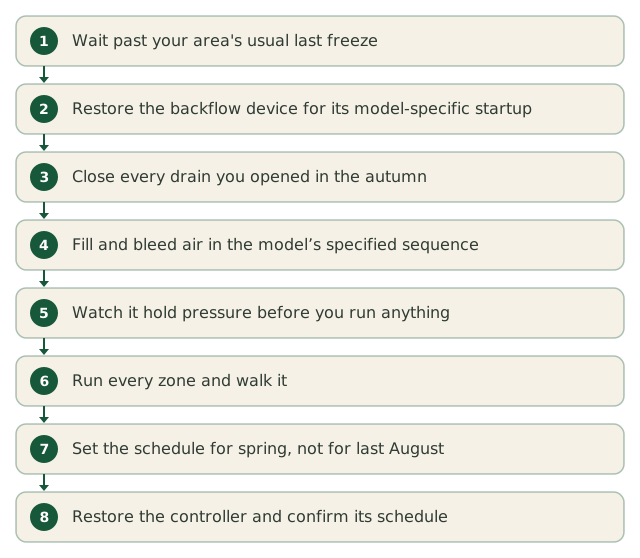
Turn a sprinkler system back on after your average last spring freeze plus a margin, with a clear forecast — no date rules out a later freeze. Restore the backflow device by its model's startup instructions, close every drain you opened in autumn, fill and bleed air in the specified sequence, and confirm it holds pressure before running each zone.
Before restoring water, identify the backflow model and check how the system was winterized. Restore removed parts and drains as its instructions require, then follow its filling and air-bleeding sequence. Winter-storage valve positions are not startup positions. Different models require different valve movements; inspect for leaks as pressure returns.
Working through it
- Step 1
Wait past your area's usual last freeze
Charging a sprinkler system before a late freeze just re-creates the problem you spent the autumn avoiding, with the added irony of doing it deliberately. Use your area's average last spring freeze as the earliest sensible date, give it a margin, and check the forecast — no date rules out a later freeze.
- Step 2
Restore the backflow device for its model-specific startup
If parts or the assembly were removed, reinstall them only as the exact model’s manual directs. Close or restore drains and test cocks, and set the isolation valves to that model’s starting positions before admitting water. For example, FEBCO 850/860 Small starts with drains, test cocks and both ball valves closed. Do not fill with valves left at their 45° winter-storage position. Arrange any required backflow service or test.
- Step 3
Close every drain you opened in the autumn
If you drained by gravity rather than blowing the system out, the boiler drain downstream of the shut-off and each zone's manual drain valve have been sitting open all winter. Walk the same route you took in the autumn and close them all, refitting any drain caps you removed. Automatic drain valves look after themselves — they reseat once the line has pressure — but a manual drain does not, and it will happily discharge at full mains pressure the moment you open the main.
Check the indoor boiler drain before anything else. It is the one that empties into a basement rather than onto grass.
- Step 4
Fill and bleed air in the model’s specified sequence
Follow the installation’s startup instructions for the supply, backflow and downstream piping. For FEBCO 850/860 Small, the manual starts with a slow main-supply opening, then a slow inlet-ball-valve opening; bleed each test cock as directed before slowly opening the outlet. Watts 800M4/LF800M4 differs: its outlet starts closed, the inlet opens until water discharges from the bonnet, then the inlet opens quickly to pressurize before opening the outlet. These are named examples, not interchangeable instructions; use the exact model’s full procedure or qualified service.
Do not use a universal valve-opening speed or winter-storage position for startup. If the model, removed parts or drain layout are unknown, get qualified help before pressurizing.
- Step 5
Watch it hold pressure before you run anything
With the system full but no zone running, stand at the backflow device for a minute and watch. Drips at the assembly, weeping valves, or the sound of water moving when nothing is on all point at a winter casualty — and they are far cheaper to find now than in July as a dead zone and a water-bill spike.
- Step 6
Run every zone and walk it
Run each zone for a few minutes and walk it while it sprays: clear clogged nozzles, straighten heads the winter heaved, re-aim anything watering the driveway, and replace cracked heads now rather than in the first heat wave. Check the controller's clock, program and backup battery while you are there.
- Step 7
Set the schedule for spring, not for last August
Whatever the controller was running when you shut it down was tuned for peak summer demand. Spring turf needs far less, and starting the season on August run times wastes water and encourages shallow rooting just as the lawn is establishing its depth for the year.
- Step 8
Restore the controller and confirm its schedule
If a non-pump controller stayed powered in off/rain, return it to Run/Auto after the system is ready. If power or pump-start connections were disconnected, have them restored under the controller and pump instructions by qualified service before operation. Check the clock and program, restore settings if needed, and confirm the next scheduled start and an actual completed cycle.
When does your last freeze usually fall?
The right sprinkler winterization method depends on your equipment, and the planning window depends on your location. Enter your ZIP for the NOAA freeze normals of the station we match to it — free, no signup required.
Free · no signup · NOAA 1991–2020 normals
Where this job usually trips people up
- When should I turn my sprinkler system on in spring?
- Turn a sprinkler system on in spring after your area's usual last freeze — your average last spring freeze is the earliest sensible anchor, with a margin on top, and the forecast should look clear. No date rules out a later freeze. Turning it on early and then getting a freeze puts you back where you started, deliberately.
- How should I pressurise my sprinkler system in spring?
- Follow the exact installation and backflow model’s filling and air-bleeding sequence. Many procedures limit filling speed to reduce pressure surges, but some devices need a specific quick inlet movement to seat their internal parts. FEBCO 850/860 Small and Watts 800M4/LF800M4 use different sequences. Neither uses a generic 45° storage position as permission to fill the system. If the model is unknown, arrange qualified service.
- What should I check first at spring startup?
- Check the backflow preventer first, while the system is holding pressure but not running. It is the component most likely to have been damaged over winter and the one where damage is visible without digging.
Get the reminder without scrolling back up
Enter your ZIP and we’ll set up the same reminder the ZIP tool higher on this page offers, timed to when it actually matters for your area.
Free · no signup · NOAA 1991–2020 normals
Where this guidance comes from
The university extension and public-agency publications listed here back specific statements on this page. Each publication says which statement it backs, so you can check the statement rather than take it on trust. Where a product label or your local extension office disagrees with anything here, follow the label or the extension office.
- Home Sprinkler Systems: Preparing Your Sprinkler System for Winter (Fact Sheet 4.719)
Colorado State University Extension
Close the backflow test cocks and ball valves before pressurizing, then open slowly to avoid water-hammer damage — the page's point that winter-storage positions are not startup positions.
- Water Hammer In Irrigation Systems (CIR828/AE066)
UF/IFAS Extension
Empty pipelines should be filled as slowly as possible so trapped air can escape, the surge risk behind the page's advice to fill and bleed air in a set sequence.
- Irrigation System Maintenance
Utah State University Extension
Check the controller before the first run, run one zone at a time to find faults, and use less water in spring than in summer heat — the page's walk-and-reset steps.
- Spring Irrigation Startup
UC Master Gardener Program of Contra Costa County (UC ANR)
Run each zone and inspect the sprinklers while they spray, the zone-by-zone walk the page recommends for finding clogged, tilted or broken heads.
- 1991-2020 U.S. Climate Normals: Annual/Seasonal Normals Documentation
NOAA National Centers for Environmental Information
The 'wait for the last freeze' anchor uses NOAA's 1991–2020 normals for the median (50% probability) date of the last spring 32°F freeze.
