
Year-round
Moss in Your Lawn? Check the Growing Conditions First
Moss often fills places where grass has thinned. Shade, lingering moisture, compacted soil or low fertility can give it an opening. Before buying lime or a moss treatment, check what is limiting the grass and whether that spot is suited to a lawn at all.
How to tell
- Moss forms small leafy tufts or a soft mat between sparse grass plants. A slick film or dried crust may be algae instead.
- Compare the patch with healthier turf: does it sit under a tree, beside a shaded wall or along a worn path?
- Look after rain and irrigation for puddles, sprinkler overlap or soil that stays wet longer than nearby areas.
- Moss alone cannot tell you the soil pH or prove a nutrient deficiency; use a laboratory soil test.
What to do
- Step 1
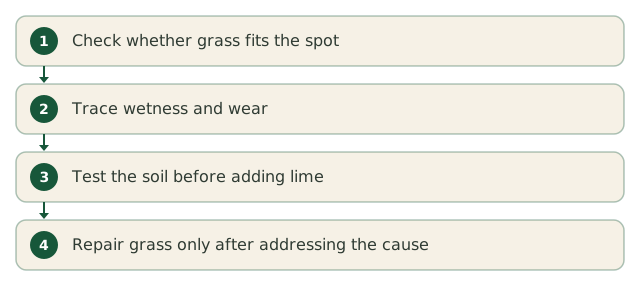
Check whether grass fits the spot
Observe sunlight through the day while trees are in leaf. Heavy shade can make a lawn impractical, even with shade-tolerant seed. Keeping established moss, using mulch or choosing a locally suitable groundcover may fit better. Ask an arborist before pruning large trees; avoid cutting exposed roots.
- Step 2
Trace wetness and wear
Check for irrigation leaks and unnecessary watering. Shaded turf generally needs less irrigation than sunny turf, but tree roots can also leave it dry: check the soil before changing the schedule. Reduce traffic on wet ground. Core aeration can help compacted soil when grass is actively growing; persistent standing water may need a drainage assessment.
- Step 3
Test the soil before adding lime
Ask a soil-testing lab how to sample the affected area and identify your grass on the submission. Lime can help when soil is too acidic for that grass; it does not kill moss directly or change the amount of sunlight. Use the soil-test recommendation and product label to determine the lime rate and any split applications. Different grasses have different pH needs, so skip routine liming without a test.
Use agricultural lawn lime only when recommended. Follow the soil-test recommendation and product label; do not substitute caustic quicklime or hydrated lime.
- Step 4
Repair grass only after addressing the cause
If the site can support grass, rake out moss and repair the thin area in your grass's local growing window. Cool-season fescues can suit some partly shaded northern or transition-zone lawns; St. Augustine or selected zoysia cultivars can suit partial shade in warm regions. Ask local Extension which species, cultivar and planting method fit. A shade-seed mix cannot overcome dense shade or waterlogged soil.
Start with a soil test
A lab result helps you decide whether lime belongs in the plan. Use our guide to collect a sample and understand the recommendation.
Read the soil-testing guide →Get the next seasonal job sent to you
We'll email you about three weeks before this ZIP's normal first freeze — while irrigation contractors still have slots, and before the backflow preventer is the part that freezes.
The blow-out reminder counts back from your metro's NOAA 1991–2020 median first freeze, not this year's forecast — a normal year, give or take a couple of weeks. Add your address and the reminder follows the live forecast for your own yard, with the checklist built around the zones and shut-offs you've mapped.
Preventing it next season
Keep mowing within the range recommended for your grass and cultivar, using the higher end in shade. Review irrigation and foot traffic in the problem spot, and base soil amendments on testing. If turf repeatedly thins under the same canopy, reconsider the groundcover before reseeding again.
The habit that makes it worse
- The belief
- “Spreading lime will kill the moss and bring the grass back.”
- What’s actually happening
- Moss often occupies gaps where turf struggles with shade, moisture, compaction or poor fertility. Acidic soil can be one factor, but moss alone does not establish that diagnosis.
- What it leads to
- Repeated liming without a soil test can raise pH beyond what the grass needs while leaving the shade or drainage problem in place.
- What to understand instead
- Lime helps grass only when a pH correction is needed; it has no direct effect on moss. Use a soil test for your grass and the product label for the rate. Address the site's growing conditions, and consider another groundcover if it stays too shady for turf.
What people ask about it
- Does lime kill moss in a lawn?
- Lime raises soil pH and has no direct moss-killing effect. It may help grass compete if a soil test shows the soil is too acidic for that grass. Get the application rate from the test recommendation and product label; moss is not a reason to guess a rate.
- Can I leave the moss instead of growing grass?
- You can leave moss instead of growing grass: existing moss can be a suitable groundcover where turf struggles, particularly in a lightly used shady area. For a busy walking route, consider a path; moss does not tolerate heavy traffic well. Mulch or regionally suitable shade plants are other options.
- Should I use a moss killer?
- Before using a moss killer, start with the site conditions that let moss in. Raking can remove moss, and a product specifically labeled for moss in lawns is another option where appropriate. Check turf compatibility, application directions and restrictions on the label. Removal leaves space that needs suitable groundcover; moss can return if the conditions still favor it.
