
Winter annual pre-emergent timing
Fall Pre-Emergent in Boise, ID
Check the label first on any ground you are seeding this autumn: many pre-emergents can injure new grass. Elsewhere in Boise, ID, if winter annuals are your target, a labeled fall pre-emergent goes down, watered in as its label directs, before about September 19 in a typical year — the median date shallow soil cools through ~70°F and winter annuals start germinating. The ~65°F median, germination well underway, is October 3: 14 days later, a distance between two medians rather than a margin any one autumn gives you.
First: are you seeding this autumn?
Settle the seeding question before you look at a fall pre-emergent date. Many pre-emergents can injure seedlings or prevent grass from establishing. Virginia Cooperative Extension states it plainly in its fall lawn care guidance: if you are planning a fall planting, these materials "will also prevent cool-season turfgrass seed germination". NC State says the same of the fall application for annual bluegrass — it "will prevent any reseeding of tall fescue and other cool-season grasses". Those warnings describe the usual conflict with conventional fall preventers.
Whether treatment and seeding fit in sequence is the exact product label's answer. An at-seeding product is not necessarily a substitute for the usual fall Poa annua prevention program, as explained below. The exclusion follows the treated ground rather than the property line: an area you are not seeding can still be treated.
In Boise, ID the seeding window and the fall pre-emergent window are effectively the same weeks. The cool-season renovation window runs August 26 – September 9, which is six to eight weeks ahead of a median first freeze on October 21, and the pre-emergent window typically opens September 19 — 10 days after the last worthwhile day to seed. Whether that is enough is not the calendar's to answer: the wait a residual product needs between the two jobs is set by its active ingredient and rate, and a few products are labeled for use at or near seeding. Take the interval from the label of what you actually intend to apply.
If you have already applied a pre-emergent, or are about to, the wait before seed can go down is the part people get wrong.
Most conventional pre-emergents can injure seedlings or prevent establishment. Before seeding treated ground, follow the exact product's reseeding interval for the rate used; waits are often months, not weeks. Before treating newly seeded grass, follow its separate waiting, mowing and establishment requirements. Use a product at seeding only when its label allows your grass species, seed mixture, rate and timing. For crabgrass prevention while seeding cool-season grass, mesotrione products with new-seeding directions are an option only for the existing turf and seed mixture that product lists. Species and timing differ by product, especially for fine fescue; avoid over-application, particularly with perennial ryegrass.
Mesotrione products with new-seeding directions are an option for specified cool-season grasses, not a replacement for the usual fall Poa annua program. Tenacity lists pre-emergence suppression only; Scotts Built For Seeding does not list Poa annua. Their species lists also differ, especially for fine fescue. Check the exact product's species, seed mixture, rate and timing. Seed first and treat later only when the chosen product's waiting, mowing and rooting requirements are met, or skip fall prevention on that area. Follow the separate new-turf directions after emergence.
If you are not seeding: the window in Boise, ID
- Median soil crossing
- September 19
- Soil cooling through ~70°F — the barrier goes down before this, not on it. Range across sampled years: September 12 – October 4.
- Germination underway
- October 3
- Soil at ~65°F on a 7-day average — past this a pre-emergent is late for what is already up.
- Between the dates
- 14 days
- Opening median to germination median — two separately summarized dates, not a typical year's interval. Zone 7.
Typical fall pre-emergent dates for Boise, ID, not a forecast: the median crossing in 2016–2025 historical soil-temperature estimates, with the earliest and latest years beside it. The threshold was crossed in 10 of the ten years sampled — only a year that crossed can count toward a median. A shaded or irrigated yard cools sooner than a bare south-facing one, so let a soil thermometer have the final say. Rates, intervals and the maximum you may apply in a year are on your product's label, which is the legal authority.
Boise, ID’s autumn, in numbers
Across the ten years of historical soil-temperature estimates behind this page, Boise, ID's 7-day soil average first fell to and stayed at or below ~70°F on September 19 in a median year. Soil reaches ~65°F around October 3, 14 days later. Both are medians over the years each threshold was actually crossed, which need not be the same years, so that is the distance between two published medians rather than a margin any one autumn gives you. The free reminder is anchored to that same median for properties whose ZIP starts 836 and 837 — the prefixes this dataset covers for Boise, ID: it reads no weather at all and has two send dates off this page's number: one a week ahead that says to apply and water in — ahead of this date, as this page advises — and one on September 19 itself as a backstop if it isn't down yet. It fires on whichever of those dates you already have the alert switched on for, so enabling it late means one send or none rather than two. A ZIP curated to a different metro is anchored to that metro's median instead of Boise, ID's; only a ZIP this dataset does not curate at all falls back to the forecast path, which fires at most once.
The fall pre-emergent window is not a fixed date. In Boise, ID the crossing has landed anywhere in September 12 – October 4 — a span of 22 days. 22 days of movement — moderate by national standards, and wider than the 14-day distance between this metro's two published medians.
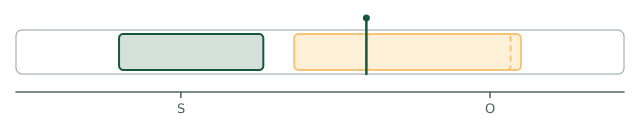
- Range of the crossing across the sampled years
- Median crossing (September 19)
- Germination underway (October 3)
- Cool-season seeding (August 26 – September 9)
Let the next date come to you instead
Boise, ID's own median lands around September 19 (range across sampled years September 12 – October 4), with germination typically underway by October 3 — bookmarking this page won't move with it. A seasonal reminder for your own ZIP does, for whatever's actually next on your calendar.
We'll email you about three weeks before this ZIP's normal first freeze — while irrigation contractors still have slots, and before the backflow preventer is the part that freezes.
The blow-out reminder counts back from your metro's NOAA 1991–2020 median first freeze, not this year's forecast — a normal year, give or take a couple of weeks. Add your address and the reminder follows the live forecast for your own yard, with the checklist built around the zones and shut-offs you've mapped.
One application here, or two?
Before any interval: whether a second pre-emergent application is permitted at all is a property of the product, not of Boise, ID and not of the September 19 crossing above. Some pre-emergents are a single application for the year, and where two are allowed the interval and the combined ceiling are both on the label. What follows is what extension services publish for each kind of lawn — useful for recognizing which pattern you are being shown, and not a schedule to follow before you have a product in hand.
Zone 7 is the widest overlap in the schedule catalog — 4 warm-season grasses (Bermuda, Zoysia, Centipede and Buffalograss) and 7 cool-season ones (Tall Fescue, Kentucky Bluegrass, Perennial Ryegrass, Fine Fescue and others) are all rated for it — so which of the two published patterns applies around Boise, ID turns on your grass, not on your ZIP. On warm-season turf: Clemson's bermudagrass and zoysiagrass maintenance calendars both put a pre-emergent down in September "with a second application 8 to 10 weeks later", and its warm-season weed guidance gives the interval as "eight or nine weeks after the first" for season-long control. UGA gives the reason rather than just the number: "A second application can be applied in winter to control later germinating plants."
The cool-season fall pre-emergent schedule this page can cite is a single application, and the seeding conflict above is why — autumn is the seeding season, so the fall application is the thing that has to fit around seeding rather than the reverse. Virginia Cooperative Extension's fall lawn care guidance describes one mid-fall application, and positions it as a follow-on to a late-summer seeding rather than as a program of its own.
What makes a second fall pre-emergent application a question at all is how long germination runs. University of Tennessee Extension puts it in months rather than weeks: once soil temperatures fall below 70 degrees F, "germination of annual bluegrass seeds will begin and continue for the next 2-3 months". Measured from Boise, ID's own crossing on September 19, that runs to somewhere around November 18 – December 18. Whether the product you choose holds that long is a property of the product, and it is on the label.
Whichever published pattern applies, a pre-emergent split is a DIVISION of one year's allowance and not an addition to it. Penn State Extension is explicit that where more than one pre-emergence application is made in a season, "most product labels recommend using rates lower than the maximum annual application rate for each of the two applications". Kansas State describes the same thing as a half rate each time. NC State's entries for prodiamine products record that the maximum yearly rate differs by turf species, and that a label can cap the active ingredient over any 12-month period rather than per calendar year — which is how a fall application and the following spring's can come out of one allowance. This page states no rate for exactly that reason: which product, at what rate, how many times and how far apart are all label questions, and as Clemson puts it, the label is the law. Worth doing the arithmetic here: Boise, ID's fall crossing on September 19 and its spring one on April 4 are 197 days apart, so where the same active ingredient goes down both times, a label counting a rolling 12 months puts both inside one allowance.
Autumn and spring are one program
A fall pre-emergent is not a separate job from the spring one — it is the other end of the same program, aimed at the weeds that germinate as soil COOLS rather than as it warms. Purdue's turf program describes exactly that pairing for annual bluegrass: a pre-emergent "applied around Labor Day and again in the early spring". In Boise, ID the two crossings are 197 days apart — the fall one around September 19, the spring one around April 4. That is a middling winter gap: wide enough that September 19 and April 4 sit in different seasons, narrow enough that one rolling 12 months holds both crossings and any application timed to them. What the two add up to inside that year is the label's arithmetic, not the calendar's.
The national calendar, set against Boise, ID
Ranked by median opening date, Boise, ID is the 29th earliest of the 83 metros here that have a crossing to rank. That places Boise, ID in the middle half of the national range, with 28 published medians before it and 54 after. What the ordering cannot do is tell you how any fixed national date sits against this metro — the spread below is what the record holds instead. For scale: Duluth, MN opens the national ordering on July 30 and Tampa, FL closes it on November 27, and this crossing falls 51 days after the first and 69 days before the last.
The metros that open just before Boise, ID are Charleston, WV (September 18), then Blairsville, GA (September 18); just after it come Milwaukee, WI (September 21), then Chicago, IL (September 23). Nothing else in the dataset crosses on exactly Boise, ID's day, so there is no twin to borrow a date from.
Boise, ID is the only Idaho metro in this dataset, so the useful comparison crosses a state line: the nearest published station is Spokane, WA, about 287 miles away, opening around September 13 — 6 days earlier. 287 miles is far enough for soil to cool on its own schedule, so treat that as a sanity check rather than as your date.
Boise, ID is a metro where the first-frost shortcut works. The hub page for this topic answers the country with one offset — apply roughly 21 to 63 days ahead of the first frost — and here the soil crossing lands 32 days before a median first freeze of October 21, inside that window. Worth knowing what that agreement is, though: it is between two AVERAGES drawn from different records — a 1991–2020 freeze normal and a 2016–2025 soil record — and neither is a statement about one autumn. This page holds no paired year-by-year comparison of the two, so it cannot tell you how often the shortcut lands where the soil actually does.
Before the fall pass in Boise, ID
- When should I apply a fall pre-emergent in Boise, ID?
- In a typical year a fall pre-emergent in Boise, ID goes down before September 19 — the median date the city's shallow soil cools to and stays at or below ~70°F on a 7-day average, which is when winter annuals start germinating. The barrier has to be down and watered in ahead of that, not on it. Because the date has ranged September 12 – October 4 across the record, read a soil thermometer rather than applying on the same weekend each year.
- Can I apply a fall pre-emergent and overseed in the same autumn in Boise, ID?
- Pairing a fall pre-emergent with overseeding depends on the exact product and when you seed. Do not assume an earlier application has cleared. Many pre-emergents can injure new grass, so on an area you are seeding any overlap needs product-specific label permission, and in Boise, ID the two windows are only 10 days apart at the medians: seeding runs August 26 – September 9 and the barrier's window opens September 19. At-seeding use needs explicit label permission for the species, mixture, rate and timing. Most conventional pre-emergents can injure seedlings or prevent establishment. Before seeding treated ground, follow the exact product's reseeding interval for the rate used; waits are often months, not weeks. Before treating newly seeded grass, follow its separate waiting, mowing and establishment requirements. Use a product at seeding only when its label allows your grass species, seed mixture, rate and timing. For crabgrass prevention while seeding cool-season grass, mesotrione products with new-seeding directions are an option only for the existing turf and seed mixture that product lists. Species and timing differ by product, especially for fine fescue; avoid over-application, particularly with perennial ryegrass.
- Is it too late for a fall pre-emergent in Boise, ID?
- Whether a fall pre-emergent is too late in Boise, ID turns on germination, not a date on a calendar. Once soil there is past ~65°F — typically around October 3 — this season's winter annuals are coming up, and most pre-emergents can't control a plant that has already emerged. Germination runs for weeks rather than finishing in a day, so an application just past that line still catches the stragglers; well past it, the honest answer is a post-emergent option now and an earlier start next year.
- Does one application cover the whole season in Boise, ID?
- Whether one fall pre-emergent application covers the whole season depends on the product, not on Boise, ID — though locally, germination runs from the September 19 crossing to roughly November 18 – December 18 on University of Tennessee Extension's two-to-three-month figure, of which the first 32 days fall before the median first freeze. The section above sets out which pattern extension publishes for which grass, and the constraint underneath both: a split divides one year's labeled allowance rather than adding to it. Your label decides.
- Does my USDA zone tell me when to apply in Boise, ID?
- A USDA hardiness zone does not set fall pre-emergent timing in Boise, ID, and this page's dataset shows that rather than asserting it. Boise, ID is zone 7, and the 21 zone-7 metros in this dataset spread 71 days apart on their own crossings — from Tahoe City, CA on August 7 to Oklahoma City, OK on October 17. A hardiness zone measures average winter cold, not how fast shallow soil gives up its summer heat in autumn, so latitude, elevation and how maritime the climate is all move the crossing inside one zone band — which is why this page is built on historical soil-temperature estimates for Boise, ID. What the zone does place is the catalog: which grasses are rated viable at zone 7, and so which of the two published patterns this page leads with. Which one applies to your lawn is settled by what is growing in it, not by the band and not by this page.
- My yard in Boise, ID has both warm- and cool-season grass. Now what?
- A yard in Boise, ID with both warm- and cool-season grass falls under both published fall pre-emergent patterns, each on a different part of the same lawn. What the catalog can say is why that combination is available at zone 7 — 4 warm-season grasses and 7 cool-season ones are all rated for it — and not how common it is around Boise, ID, which is not something this page holds. Treat the areas separately. On an area you intend to seed, use a pre-emergent only when its exact label permits your grass species, seed mixture, rate and seeding stage. For an earlier application, follow its reseeding interval before sowing. Nothing about the local climate resolves this for you — the grass does, and so does the label of whatever you are holding.
- Do I still need a spring pre-emergent in Boise, ID if I apply one in the fall?
- Fall and spring pre-emergents are aimed at different weeds, which is why one is not automatically a substitute for the other — and not a reason to make both either. The fall application at winter annuals that germinate as soil COOLS through ~70°F, around September 19 here; the spring one at crabgrass and the other summer annuals that germinate as soil WARMS back through ~50°F, around April 4. In Boise, ID that is 197 days apart. Whether the spring half is worth doing is a question about your lawn — whether those summer annuals are actually a problem in it — and about your product, not about the two dates existing. What the dates do settle is that these are one program rather than two errands: where the same active ingredient goes down both times and its label states a maximum for any 12-month period, both applications draw on that one allowance.
- How far apart are Boise, ID's two published dates?
- Boise, ID's two published fall dates are 14 days apart: soil crosses ~70°F around September 19 and reaches ~65°F around October 3. Both are medians over the years each threshold was actually crossed, so that is the gap between two medians and not a measurement of a typical autumn. Aim to be finished before the front of it rather than inside it — a pre-emergent needs rain or irrigation to move it into the top layer of soil before it is doing anything at all, and that watering-in takes days you do not want to be spending after germination has started.
