
The YardLedger journal
How to keep a lawn-care journal you will actually use
A practical guide to logging mowing, watering, treatments, photos, and soil tests—with a worked example and a lawn-care journal template you can reuse.
Key takeaways
Start with the date, the part of the yard, what you did, and what you noticed.
Keep plans separate from completed work. “Water tomorrow” is not a watering record.
Save the product label and soil-test report alongside your notes, rather than relying on memory.
Compare observations over time before deciding that one treatment caused a change.
You finish mowing, put the tools away, and tell yourself you will remember what the lawn looked like. A month later, the details blur. Was that thin patch there before you seeded? Did you water the side yard, or only plan to? Which bag did you use last time?
A useful lawn-care journal gives those questions somewhere to land. It does not need an entry every day or a perfect history. Start with the next thing you do and leave enough detail that your future self can understand it.
Start with a record you will actually keep
Choose one place for the history: a notebook, a spreadsheet, or a lawn-care app. The format matters less than whether you can find an entry when you need it. If your notes currently live in three places, bring the new entries together first; backfilling years of history can wait.
Use the same names for the same areas. “Front lawn,” “shady side,” and “back lawn” are more useful than a note that simply says “yard.” Write down a measured area if you have one. If it is an estimate, say so. A rough estimate should not quietly turn into an exact measurement later.
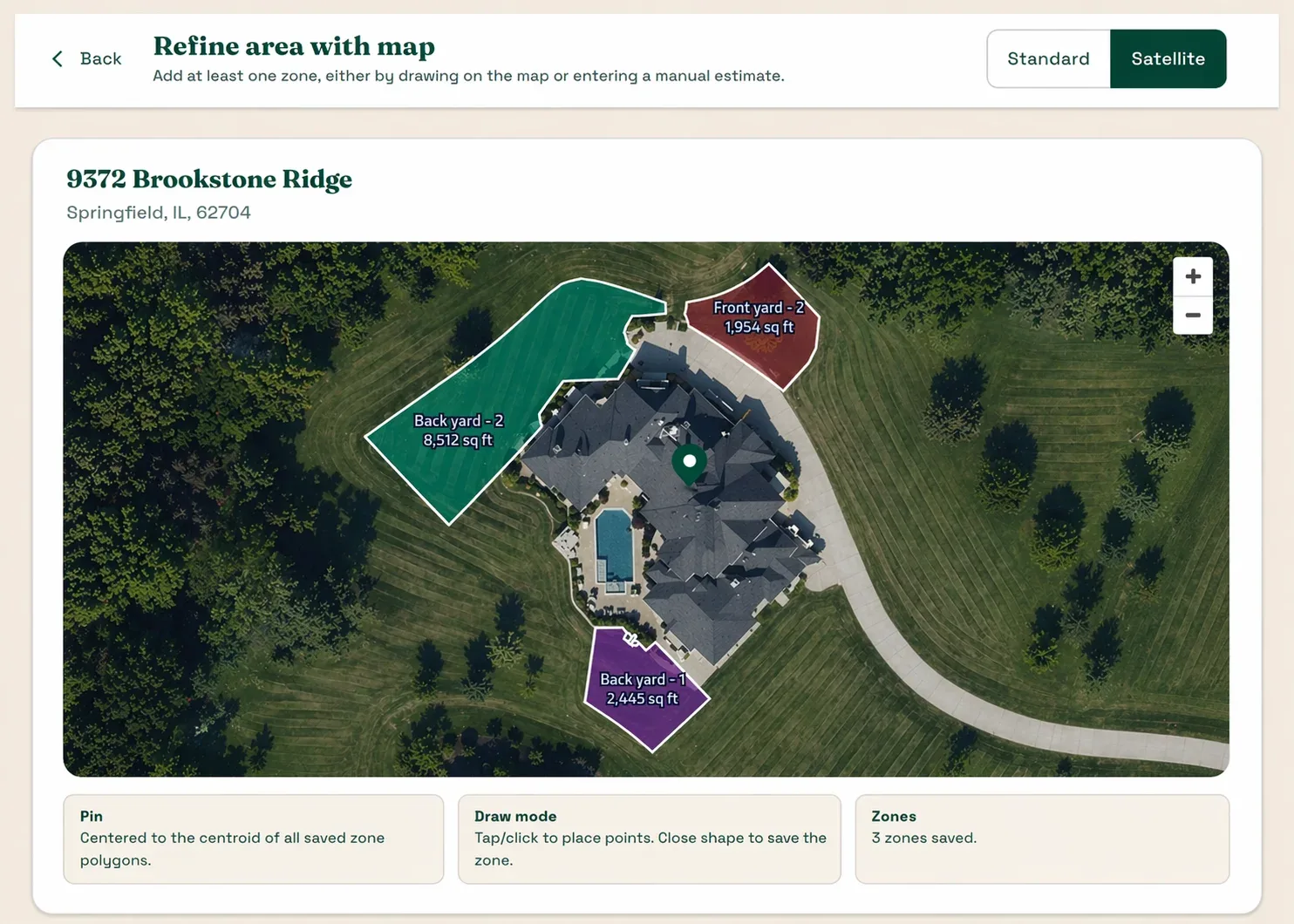
In YardLedger, you can use named zones to organize parts of a property. The example above shows separate areas on the map. A journal can follow the same idea even if you are starting with a sketch on paper.
What to write down after each task
Keep the entry short enough to finish before you forget. These fields form a practical starting point; you do not need every field for every task.
Record | Useful detail | Why keep it? |
|---|---|---|
Date and place | When it happened; which lawn or zone | Separates one visit or area from another |
Work completed | Mowed, watered, seeded, applied a product, or inspected | Keeps completed work distinct from a plan |
Product or equipment | Exact product name; equipment setting when relevant | Gives you something concrete to check later |
Amount and area | What you actually used; units; measured or estimated area | Preserves the original observation without inventing precision |
Conditions | What you noticed about rain, soil, shade, or traffic | Adds context to the entry |
Follow-up | A photo or note from a later visit | Lets you compare the same location over time |
For an application, keep a copy or photo of the label. Record the amount actually used rather than copying a suggested amount into a completed entry. Your history is a record of what happened; it does not establish that an application was suitable. Follow the product label and applicable local rules before applying anything.
For watering, distinguish sprinkler runtime from an amount of water. “Ran for 20 minutes” records time. It does not, on its own, tell you how much water reached the grass. If you want to explore watering inputs, start with the lawn watering calculator.
A worked example: turn a vague note into a useful one
“Lawn looks bad. Mowed.” will be hard to interpret later. A more useful entry might read:
Illustrative journal entry — not a care recommendation
Date / place: October 8, back lawn near the gate.
Completed: Mowed. Mower deck was set to 3 inches; actual cut height was not measured.
Observed: The strip beside the gate looks thinner than the center of the lawn. Took a photo from the patio facing the gate.
Next check: Photograph the same strip next weekend. No treatment chosen yet.
The entry separates an equipment setting from a measurement and an observation from a diagnosis. It also leaves a clear next step without pretending that step has already happened. The example's mower setting is an illustration, not a suggested height for your grass; use the mowing-height guide for grass-specific context.
Make photos useful for comparison
Take an overview that shows where the problem is, then a closer image of what you are trying to document. For a later comparison, return to roughly the same spot and direction. Record the date and area with the image, so it still makes sense outside your camera roll.
Different light, freshly mowed grass, rain, and a changed camera angle can all make two pictures look different. Treat a photo as one observation to compare with your notes, not proof that a product worked. If you cannot tell what changed, write that down too.
Keep soil-test results with the history
Save the original report and the sample date, lab, and sampled area. Soil testing can provide information about nutrient status and pH; the University of Minnesota Soil Testing Laboratory explains what its lawn and garden tests include. Use a lab suited to your location and follow its sampling instructions.
If you act on a report, record that later work as a separate entry. A recommendation on the report is not evidence that you applied it. Our soil-test guide is a useful next read when you are deciding what to do with a result.
Review the record before making the next plan
At your next planning session, look back at the relevant area rather than only the latest photo. What actually happened? What was merely planned? What is still uncertain? That review can reveal a missing detail to check before you choose another task.
For a starting point on seasonal timing, use the lawn-care schedule generator, then consider your grass, location, conditions, and recent work. A calendar is a plan. Keep the completed history honest even when the plan changes.
Common questions
Do I need to record something every day?
No. Start with work you completed and observations you will want to compare. A brief entry you can understand later is more useful than a long daily form you stop filling out.
Can I add work I did before I started the journal?
Yes, but label uncertain dates and amounts as estimates. Keep receipts or photos that help establish the details. If you do not remember an amount, leave it unknown rather than choosing a plausible number.
Does a journal tell me why my lawn improved?
A journal helps you compare events and observations. It does not isolate causes: weather, seasonal growth, mowing, and several treatments may have changed together. Record what you observed and keep your explanation separate from the observation.
Sources and next steps
University of Minnesota: lawn and garden soil testing — what that laboratory measures and how to submit a sample.
YardLedger soil-test guide — context for planning a test and reading the result.
About YardLedger — who builds the app and how it works.
Pick one area of your lawn and write one entry after the next task. Date, place, completed work, observation. You can add detail as the record becomes useful.